How PEI Gets Composting Right
Prince Edward Island has one of Canada’s longest-running composting systems.
Larger provinces often rely on layered infrastructure and complex enforcement systems, but PEI’s approach combines consistency, clear rules, and province-wide participation.

For a more in-depth look, read Inside Canada’s Composting Systems by Madeline Roquemore.
Waste Watch Started Early
PEI’s Waste Watch program launched in the early 1990s.
Today, it operates as a mandatory three-stream waste separation system across the province. Residents sort materials into:
Compost
Recycling
Garbage
Households receive colour-coded bins and follow a standard collection schedule. Compost and garbage collection are on alternating weeks, while recyclables pickup is monthly.

Critical Sorting Rules
One reason the program works is consistent enforcement of participation rules. Drivers inspect bins at pickup. Improperly sorted materials are tagged or refused. Even using the wrong-coloured bags results in rejection.
That visibility lowers contamination levels and helps system efficiency.
What Happens After Collection?
Once collected, organics are transported to PEI’s centralized composting facility in Brookfield.
The facility processes up to 30,000 tonnes of material annually using enclosed in-vessel composting containers. The setup controls odours and protects groundwater while maintaining compost quality.
Finished material becomes Category A compost suitable for agricultural use.
The entire system is coordinated through the Island Waste Management Corporation, which oversees collection, logistics, processing, and public education.
The Bigger Role of the Compost Council of Canada
Beyond provincial programs, national organizations also help keep composting systems functioning effectively.
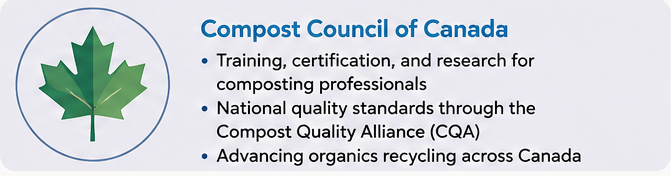
The Compost Council of Canada plays a major behind-the-scenes role by supporting:

Training programs
Operator certification
Compost quality standards
Municipal guidance
Research and advocacy
The organization also promotes composting as part of Canada’s broader climate strategy, particularly to reduce methane emissions and improve soil health.
Canada’s Composting Challenges Remain
Infrastructure gaps remain. Access varies by region. Contamination continues in many communities. What works in PEI may not work in Vancouver or northern Canada.
Still, one theme appears across successful programs.
Clear rules. Public participation. Infrastructure.
Canada’s composting systems look different province to province, but the goal stays the same. Keeping food waste out of landfills and turning it into something useful.


