Policy Brief: Retrofitting Affordable Housing for Sustainability
July 15, 2026
By Julia Manese and Afra Nawar
Community-Scale Solar and Storage Policy Brief
Target Audience:
-
Halton Region Municipal Government
-
Halton Community Housing Corporation Key Messages:
-
Sustainable retrofits lead to long-term savings
-
Affordable housing should have eco-friendly features
-
Everyone deserves a healthy place to live Policy options:
-
Resource savings and efficiency via solar panels, HVAC upgrades, and low-flow water appliances
-
Increased greenery for climate resilience in the form of gardens, trees, and green roofs
Executive Summary
Halton Region’s rapidly growing population, in combination with the increasing effects of climate change, create the need for more affordable and sustainable housing. By working with existing affordable housing, sustainable features can be added with retrofitting strategies that increase building longevity, improve resident wellbeing, and reduce greenhouse gas emissions. We recommend that Halton Region invest in installing solar panels, replace HVAC systems and bathroom appliances with higher efficiency systems and appliances, and increase greenery around their housing communities. These sustainable retrofits, while they may have a higher upfront cost, will greatly contribute to Halton Region’s climate goals and, thus, create a more sustainable region.
Problem Statement
The Halton Region is one of the fastest growing communities in Canada and contains four municipalities: the city of Burlington, the town of Halton Hills, the town of Milton, and the town of Oakville. The Region currently has a population of more than 650,000 residents, but is expected to grow to 1.1 million residents by 2031. To accommodate rapid population growth and prevent urban sprawl, Halton Region needs more sustainable, affordable housing. Urban sprawl, defined as unrestricted urban growth characterized by low density, adds to the urban heat island (UHI) effect from increased concrete coverage and contributes more vehicle emissions by encouraging car usage. The solution to this problem should reduce greenhouse gas (GHG) emissions that come from residential sites and prioritize environmental responsibility while being economically feasible.
Climate change is increasingly affecting housing in Halton Region, partly from the increased frequency and severity of weather events, such as extreme heat or rain-induced flooding. These weather events put strain on the existing infrastructure and housing. Extreme weather also causes costly housing repairs and puts residents at risk. By investing in climate change mitigation and adaptation in the housing sector, Halton Region can safeguard public health, protect municipal buildings, and ensure long-term housing stability in the face of accelerating climate impacts.
Housing in Halton
Halton Region has actively pursued climate-resilient housing and infrastructure through its Comprehensive Housing Strategy and Strategic Plans. The Comprehensive Housing Strategy targets housing by addressing the need for more community housing, protecting the housing already in place, and creating new units. Within the Halton Region’s municipal government is Halton Community Housing Corporation (HCHC), which provides housing in communities that are healthy, safe, and enjoyable to residents. HCHC owns multiple townhouses, apartments, and single and semi-detached dwellings. HCHC has many current capital works projects in progress and completed, where they work on retrofitting their building for resident safety and wellbeing. While improvements are being made, the retrofits do not adequately incorporate sustainability or environmental principles. Our project aims to keep existing community housing in good condition while increasing sustainability.
The sustainable retrofits will be applied where possible at four of HCHC’s affordable housing buildings: two townhomes and two senior apartments. The choice for those specific buildings came at the recommendation of Halton Region. The two townhomes, Sheridan Woods and Golden Briar Heights, are located in Oakville and populated by families in 2-4 bedroom units with 51 and 88 total units respectively. Both townhomes were built in the 1990s, and residents pay for utilities themselves. The two apartments are Bruce Apartments in Milton and Wellington Terrace in Burlington. Both apartment complexes are multistorey senior living facilities. Bruce Apartments’ 88 units were built in 1979, and Wellington Terrace’s 126 units were constructed more recently in 1995. Both apartments boast downtown locations. All four housing buildings have been subject to retrofits, but they were maintenance-based instead of focused on sustainability.
After a building’s construction, the bulk of a residential building’s GHG emissions are from energy usage. Residential energy is 19% of Ontario’s energy demand, and 66% of that energy is devoted to space heating and cooling. Ontario currently uses Time-Of-Use (TOU) energy pricing, which peaks in the day in the summer and in the early morning and late afternoon during the winter. Thus, any energy-related solutions must recognize these high-cost periods.
In 2024 alone, over $9 billion CAD was spent on insurable catastrophic losses from extreme weather events. For Halton Region, floods, ice storms, and extreme heat are the most likely weather-related disasters. Because of the potential losses and danger that climate change related events may cause, it is crucial that residents of Halton Region live in buildings with climate resilient features.
Defining Sustainable Cities
The United Nations created the Sustainable Development Goals (SDG) as an urgent call to action to work against climate change. The two SDGs that our project intends to support are SDF 11, Sustainable Cities and Communities, and SDF 7, Affordable and Clean Energy. In the context of Halton Region’s rapid population growth and rising housing demands, our project aims to create sustainable housing, which is defined as housing with minimal environmental impact and a focus on energy efficiency, by emphasizing renewable energy integration, water conservation, climate resilience, and affordability.
The region faces increasing development pressures and risks of urban sprawl, which heighten GHG emissions and the UHI effect. UHI explains the phenomena where built-up areas experience significantly higher temperatures than surrounding rural zones due to dark rooftops, paved surfaces, and limited vegetation. To address this, retrofitting existing residential buildings in Halton with green roofs, solar panels, low-flow appliances, and upgraded HVAC systems offers immediate benefits. Retrofitting the already existing buildings with such energy facilities will help in addressing Target 7.1, specifically indicator 7.1.2, which ensures universal access to affordable, reliable and modern energy services. Along with that, enhancing greenery through native plant landscaping, community gardens, and tree planting on site directly mitigates UHI and reduces cooling needs, while also supporting Target 11.7, access to green and public spaces and Target 11.6, reducing environmental impact. Such strategies help Halton’s transition to clean energy, supporting Target 7.2 by increasing the share of renewable energy. Efficiency measures also contribute to Target 7.3, which focuses on doubling energy efficiency improvements.
Sustainable housing strategies in Halton should combine passive design, renewable integration, nature-based cooling, and water conservation, while also encouraging behavioural adoption through community engagement. These interventions not only help meet local affordability and environmental goals but also ensure Halton is advancing toward national and global commitments under SDGs 7 and 11.
Retrofitting Strategies
While there are many ways to sustainably retrofit existing buildings, our brainstorm included the broad categories of energy efficiency and sources, water usage, and greenery.
One option to improve energy efficiency is upgrading insulation, such as seals on windows or doors, or the insulation within the walls. Another way to improve energy efficiency is to upgrade the heating, ventilation, and air condition (HVAC) system like utilizing a smart system or finding an alternative energy source. Installing solar panels, either on rooftops or as parking lot canopies, as an alternative energy source reduces the GHG emissions from energy use. Solar energy is clean, renewable energy and the most common to implement residentially.
Another sustainable upgrade is reducing water use. Toilets, sinks, and showers, all appliances used daily, can all be traded out for a low flow version to keep water use and costs low. Noninvasive flow monitors can also be added to water pipes to track leaks and verify water bills.
The final retrofit category is increasing greenery, which comes in many forms and adds both environmental and social benefits. Community gardens paired with a rainwater collection system, for example, can be implemented to connect residents to each other and benefit their local environment. Planting trees and replacing grass lawns with native plants can contribute to the urban tree canopy by providing shade and, thus, a cooling effect. The final two green interventions, accessible green spaces and green roofs, are hallmarks of sustainable cities.
We ultimately focused on the retrofitting strategies that could be implemented across all of our chosen properties: HVAC upgrades, solar panels, low flow appliances, and greenery.
Recommendations
Solar Panels
We recommend the addition of rooftop and parking canopy solar panels. Here, only Golden Briar Heights and Bruce Apartments have space for solar canopies, as they had surface parking lots. Bruce Apartments and Wellington Terrace, because of their flat roofs, have space to incorporate both green roofs and solar panels. The solar panels for Sheridan Woods and Golden Briar Heights would only be located on the southern slope of the slanted roofs. For the solar panel calculations, we assume an average solar panel of 350 W and area of 2 m2, 1166 hours of sunlight yearly, and an installation cost of $2.42 per Watt. The approximate available roof areas were calculated using the measure tool in Google Earth. Then, the installation cost and average energy savings were calculated, with results below in Table 1. From there, a payback period of 8 years was calculated for each property. A solar panel is fully functional for 25 years, so the properties would receive 17 years of free solar power. While the energy generated by the solar panels does not fully cover the 9500 kWh average household energy consumption, as seen in Table 1, it is a great step forward in switching to renewable energy. Also, the installation cost can be subsidized by different government incentives, such as Canada’s Green Home Loan or the Ontario Home Renovation Savings Program.
Table 1. Unit based installation and savings costs for solar panel retrofitting strategy.
HVAC
The recommendation for upgrading the HVAC system is to convert to an air based heat pump system. Heat pumps are advantageous over traditional heating systems because they provide both heating and cooling. Heat pumps extract heat from the air, even in colder climates, and move it into or out of the building. This would be a decentralized system, so each unit would have their own heat pump system. Adding the cooling functionality of the heat pump would greatly increase resident comfort, especially as extreme heat events become more frequent. The calculations for each unit is more dependent on what type of building, as installation and efficiency are different for townhomes and apartments. The results are displayed in Table 2.
Table 2. Heat pump savings and installation costs for townhomes and apartments.
Washroom Fittings
To improve water efficiency in residential units, we recommend retrofitting washroom fixtures with low-flow toilets, aerated faucets, and high-efficiency showerheads. These fixtures significantly reduce water consumption compared to conventional models, without compromising user experience.
Since all the properties were built prior to 1996, they are equipped with toilets that use 13 to 18 litres of water or more per flush, which is approximately six times more than the efficient models. Retrofitting with low-flow toilets not only saves thousands of gallons of water as shown in Table 3, and reduces the energy required for water transportation and water treatment, thereby lowering household carbon emissions. Moreover, they help reduce the risk of sewage overflow by reducing the volume of water entering sewage systems, which aids in reducing the spread of waterborne diseases and environmental pollution. Low-flow toilets can easily replace the older models without requiring extensive plumbing modifications because of their standard size.
Showering is the second largest source for water usage in homes. A standard showerhead uses an average of 11.25 litres per minute of water. In contrast, an efficient showerhead model uses an aerator which reduces water usage to 7.6 litres per minute. Aerators function by mixing air with water, thereby maintaining required pressure while using notably less water. It aids in saving both water and energy significantly which can be seen in Table 3, while not compromising user comfort due the wide range of efficient showerheads available. Similarly, by installing a faucet aerator into a standard faucet which uses approximately 3.5 litres of water per minute, could bring down the water usage to 1.9 litres, as demonstrated in Table 3.
Table 3. Water savings and installation cost
Greenery
Nature-based solutions are a key intervention we strongly recommend. These include strategies like installing green roofs, establishing community gardens with rainwater harvesting systems, increasing tree coverage on-site, and replacing traditional grass lawns with native, drought-resistant plants. The application of these strategies, however, varies based on the type and context of each building.
Sheridan Woods and Golden Briar Heights, the townhomes, both have slanted roofs.
Implementing green roofs on them would require more structural modification of the roof system in order to support green roofs. Thus, both the townhomes are better suited for other interventions such as native landscaping, more tree planting areas, and community gardens.
The apartment buildings Bruce Apartments in Milton and Wellington Terrace in Burlington have flat roofs and can accommodate a green roof alongside the solar panels. Wellington Terrace is located in a concrete-heavy downtown area with limited ground-level space for greenery, but the tiered roof levels of the building can be repurposed for adding community gardens, which could also bring the inhabitants of the building together. Similarly, Bruce Apartments is covered with parking lots, leaving almost no space for newly added greenery like native plants, trees or garden spaces. However, the empty space in front of the building can host a community garden with additional greenery added along the building’s edges.
Such interventions can potentially help with UHI mitigation, enhance stormwater management, improve the adaptability of buildings to temperature extremes and heavy rainfall, while also contributing to improved mental health and promoting active living for the residents.
The solar panels and greenery interventions can be seen for each property in the maps below.
Bruce Apartments, Milton | Wellington Terrace, Burlington
Golden Briar Heights, Oakville | Sheridan Woods, Oakville
Conclusion
Halton Region’s affordable housing must progress with sustainability as a fundamental principle, and this policy brief identifies three high-impact retrofit strategies that can lead the way: solar panel installations, HVAC upgrades, and water-efficient washroom fittings. These retrofits are financially sound, environmentally responsible, and adapted to the unique needs of not just the selected housing properties but may also be applied to nearly any housing building in Halton Region. By implementing these initiatives across Halton's housing projects, the region not only supports its own climate action targets, but also provides long-term benefits to residents, guaranteeing safe, resilient, and affordable housing for all. The initial investment will provide decades of utility savings, lower emissions, and healthier living conditions. The call to action is clear: prioritize funding and coordination for these long-term retrofits throughout Halton Community Housing Corporation sites to ensure a cleaner and more equitable future.
Sources and Appendices
Sources
Ascano HVAC. “How Much is a Heat Pump in Ontario?” HVAC Toronto. Accessed July 7, 2025. https://www.romaniukheatingac.com/are-heat-pumps-worth-it-in-canada/
Bonada, Anabela. “Building Climate Resilience: Adapting to Flood and Extreme Heat in Halton Region.” SSEF Presentations. June 9, 2025.
Bourland, Laura. “Low Flow Faucets and Toilets.” Rise, April 7, 2025. https://www.buildwithrise.com/stories/the-low-down-on-low-flow-faucets-and-toilets
Cairns, Stephanie, and Geoff McCarney. “Solar and Wind Energy in Canada: Value Recovery and End-Of-Life Considerations.” Smart Prosperity Institute, October 2021. https://institute.smartprosperity.ca/sites/default/files/Working_Paper_Solar_Energy_01.pdf
Cooper, Alison. “What's the deal with low-flow and dual-flush toilets?” How Stuff Works, July 16, 2012.
https://home.howstuffworks.com/home-improvement/household-hints-tips/cleaning-organizing/l ow-flow-and-dual-flush-toilets
Energystar. “Air-source heat pumps.” Natural Resources Canada, March 19, 2023.
https://natural-resources.canada.ca/energy-efficiency/energy-star/products/list-certified-products/ air-source-heat-pumps
Greenwriter. “Low-Flow Fixtures and Toilets: Eco-Friendly Plumbing Upgrades for Canadian Homes.” Modern Green Canada, December 7, 2024. https://moderngreencanada.ca/2024/12/07/low-flow-fixtures-and-toilets-eco-friendly-plumbing-u pgrades-for-canadian-homes/
HCHC. “Capital Works In Progress Review - December 31, 2024.” Halton Community Housing Corporation. Accessed June 24, 2025. https://edmweb.halton.ca/OnBaseAgendaOnline/Documents/ViewDocument/HC-03-25_-_Attac hment_2_-_Project_Closures_December_31_2024.pdf?meetingId=4543&documentType=Agend a&itemId=129467&publishId=82899&isSection=false
HCHC. “Project Closures - December 31, 2024.” Halton Community Housing Corporation. Accessed June 24, 2025. https://edmweb.halton.ca/OnBaseAgendaOnline/Documents/ViewDocument/HC-03-25_-_Attac hment_2_-_Project_Closures_December_31_2024.pdf?meetingId=4543&documentType=Agend a&itemId=129467&publishId=82899&isSection=false
MAG Solar. “Are Solar Panels Worth It in Canada?” Accessed July 3, 2025. https://magsolar.ca/are-solar-panels-worth-it-in-canada/
Nwankwo, Constance & Ebirim, Wisdom & Ninduwezuor-Ehiobu, Nwakamma & Ani, Emmanuel & Olu-lawal, Kehinde & Ugwuanyi, Ejike. INTEGRATING SUSTAINABILITY INTO HVAC PROJECT MANAGEMENT: CHALLENGES AND OPPORTUNITIES.
Engineering Science & Technology Journal. 5. March 2024. https://www.researchgate.net/publication/379252879_INTEGRATING_SUSTAINABILITY_IN TO_HVAC_PROJECT_MANAGEMENT_CHALLENGES_AND_OPPORTUNITIES
Rojini Kathiravel, Shiyao Zhu, Haibo Feng, “LCA of net-zero energy residential buildings with different HVAC systems across Canadian climates: A BIM-based fuzzy approach.” Energy and Buildings, Volume 306, 2024, 113905, ISSN 0378-7788,
https://doi.org/10.1016/j.enbuild.2024.113905. (https://www.sciencedirect.com/science/article/pii/S0378778824000215)
Rowlands, Ian. “Thinking about energy systems.” SSEF Presentations. June 3, 2025. Smith, Daniel. “ The Benefits of Low-Flow Toilets: Save Money and the Planet.” Cal’s Plumbing, March 1, 2024.
https://calsplumbing.com/the-benefits-of-low-flow-toilets-save-money-and-the-planet/
Solar Calculator. “Solar Calculator Report Ontario.” Solar Calculator Canada, Accessed July 3, 2025. https://solarcalculator.ca/report/Ontario
Stardust Solar. “Solar and Powerwall Installation.” Accessed July 3, 2025. https://stardustsolar.com/solar-quote/halton-solar-installation/
Urban, Rylan. “Solar Energy Maps Canada.” Energy Hub, August 2023. https://www.energyhub.org/solar-energy-maps-canada/#solar-energy-maps-canada
Veal, Andrew. “Homes Changing to Low-Flow Fixtures Help Create a Sustainable Future.” Blue Flow All-Service Plumbing, February 1, 2025.
https://goblueflow.com/homes-changing-to-low-flow-fixtures-help-create-a-sustainable-future/ Capital Regional District. “Indoor Water Use.” Conserving Water at Home, Capital Regional District, 2025.
www.crd.ca/environment/water-conservation/conserving-water-home/indoor-water-use. Halton Region. “Water Bills, Rates and Fees.” Water and Wastewater Billing, Halton Region, 2025.
www.halton.ca/For-Residents/Water-and-Environment/Water-and-Wastewater-Billing/Water-Bill s,-Rates-and-Fees.
Halton Region. 2024 Water and Wastewater Rates. Halton Region, 1 Jan. 2024 www.halton.ca/Repository/2024-Water-Rates-Card. PDF file.
Oakville Hydro. “Water Rates and Charges.” Accounts & Services – Billing & Payment – Water Rates & Submit a Water Meter Reading, Oakville Hydro, updated Jan. 1, 2025 www.oakvillehydro.com/accounts-services/billing-payment/water-rates-submit-water-meter-read ing/water-rates-and-charges.
Appendix: Property Level Costs
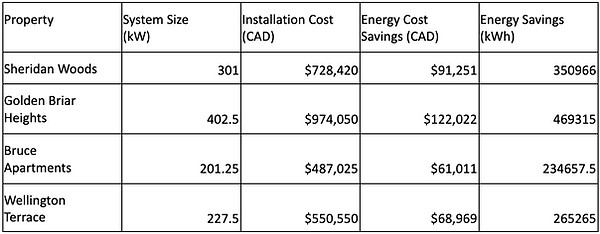
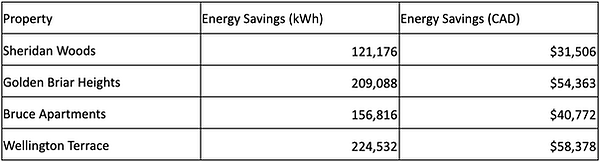
For future reference, the tables below scale the unit or household based costs up for each property, showcasing the savings and installation costs across all solutions.
Table 4. Property level costs and savings for solar panels.
Table 5. Property level savings for heat pumps.
Table 6. Property level savings for Showers
Table 7. Property level savings for Faucets
Table 8. Property level savings for Low-flush toilets