Direct Air Capture: Divisive Technology That Might, or Might Not, Work
September 29, 2026
By Denis Koshelev
-
Direct Air Capture (DAC) is a developing technology for removing carbon dioxide from the atmosphere.
-
DAC faces challenges of high energy consumption, infrastructure needs, and costs.
-
Captured CO₂ can be permanently stored underground for the greatest climate benefit, or mineralized into solid rock, or integrated into products like concrete and plastics.
-
Two main DAC approaches are solid sorbent and liquid solvent systems. They differ in operational methods, costs, and scalability.
-
DAC remains promising yet controversial due to unproven large-scale impact and whether it can deliver on climate targets.
Direct Air Capture (DAC) technology represents a critical, albeit developing, tool in the global effort to mitigate climate change by actively removing carbon dioxide (CO₂) from the atmosphere. Its technical effectiveness is a subject of intense study, as its potential to contribute to net-zero emissions targets is substantial, yet its current and near-term capacity remains limited. These limitations incite questions regarding the effectiveness of this technology. Its ability to function as a scalable carbon dioxide removal (CDR) solution is contingent upon overcoming significant hurdles related to energy consumption, infrastructure development, and cost. So, is it yet another empty promise, or are there actual, real cases of DAC success?
What is Direct Air Capture (DAC)?
DAC involves a three-step process to remove carbon dioxide from the atmosphere. First, sorbents, either liquid or solid agents, chemically bind CO₂ from the air. Next, the captured carbon dioxide is released from these sorbents by adjusting temperature, humidity, or pressure, a process that consumes significant heat and/or electricity. Systems employing liquid sorbents often require substantial quantities of water but can typically operate continuously, unlike solid sorbent systems which must pause for regeneration. Finally, the isolated CO₂ undergoes purification and processing, preparing it for either storage or reuse.
DAC extracts carbon dioxide directly from the atmosphere, irrespective of location. This contrasts with conventional carbon capture, typically implemented at emission sources like steel plants. The captured CO₂ can be permanently sequestered in deep geological formations or utilized in various industrial applications. In his 2021 book How to Avoid a Climate Disaster, Bill Gates writes: “DAC is an expensive and largely unproven technology, but if it can work at a large scale, it would allow us to capture carbon dioxide no matter when or where it was produced.”
After direct air capture, carbon dioxide is managed through three primary methods. The most common approach, geological storage, involves compressing CO2 into a supercritical fluid (it can have liquid-like density while still flowing and diffusing more like a gas) and injecting it deep underground — over half a mile down — into formations such as saline aquifers, where it remains permanently contained. Another method is mineral carbonation, where CO2 is injected into reactive rock formations like basalt. Here, it chemically reacts with minerals to form solid carbonate rocks, effectively locking away the carbon for more than 10,000 years, literally transforming the CO2 into a solid substance. Finally, product integration incorporates CO2 into materials like concrete or plastics, offering long-term storage for decades or centuries, although this capacity is limited compared to geological storage. To achieve the greatest climate benefit, the vast majority of captured CO2 must be permanently sequestered underground rather than used in ways that could eventually release it back into the atmosphere. Once properly stored beneath the surface, this sequestration requires no ongoing maintenance. (Climeworks, 2025; Friedmann, 2023; Lebling et al., 2025).
Image Credit Ozden, A., Luo, M., & Lum, Y. (2025). Point-source carbon capture and direct air capture – A technology overview. Chemical Engineering Journal, 519, 165535.
A Comparison of DAC Technologies: Solid Sorbent vs. Liquid Solvent
The field of DAC is primarily divided into two main technological approaches, each with distinct operational characteristics, energy requirements, and cost profiles: solid sorbent systems and liquid solvent systems. While both aim to achieve the same goal of removing CO₂ from the atmosphere, the underlying chemical processes and engineering designs are fundamentally different.
Solid sorbent systems use solid materials that adsorb CO₂ onto their surface, while liquid solvent systems use chemical solutions that absorb CO₂ into the liquid. This distinction has profound implications for the energy needed for regeneration, the scalability of the technology, and its suitability for different locations and energy sources. Understanding the trade-offs between these two pathways is crucial for assessing the future trajectory of the DAC industry and its potential to achieve the scale and cost reductions necessary for widespread deployment. (Mission Zero, 2024).
The long-term cost and scalability of solid sorbent and liquid solvent DAC are subject to different dynamics. Liquid Solvent DAC (L-DAC) systems, particularly those based on large, centralized plants, may exhibit lower first-of-a-kind costs because they can adapt, using several commercially available components. However, their integrated design may limit the opportunities for "learning by doing" and could result in slower long-term cost reductions. In contrast, Solid Sorbent DAC (S-DAC) systems are often designed with a modular approach, using standardized units that can be mass-produced. This modularity is ubiquitous, with faster capital expenditure reductions, as seen in the solar and battery industries, and could lead to steeper learning curves and more rapid cost declines in the long run. Therefore, while L-DAC may be cheaper to deploy initially, S-DAC may have a better trajectory for achieving the long-term cost targets necessary for gigatonne-scale deployment. (Casey, 2025).
Current Removal Capacity
The current global capacity for CO₂ removal via Direct Air Capture is in its earliest stages of development, representing a minuscule fraction of the total emissions that need to be addressed. According to the International Energy Agency (IEA), as of 2024, only about 27 DAC plants have been commissioned worldwide, capturing almost 0.01 million tonnes (Mt) of CO₂ per year. This is a tiny amount compared to the scale of global emissions that need to be removed to meet climate targets. Most DAC facilities are still in the early stages of development, and the technology is far from being deployed at the scale required for a significant climate impact. Even with all planned projects, DAC would reach only a minuscule percentage of the necessary removal capacity by 2030. (International Energy Agency (IEA) (2024)
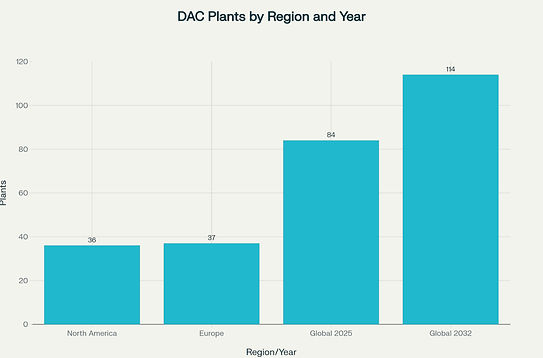
Across North America and Europe, there are dozens of operational DAC plants: about 36 in North America and 37 in Europe, located mainly in the US, Canada, the UK, the Netherlands, and Germany. By the end of 2025, a total of 84 DAC plants are expected to be operational globally, with a combined capacity of about 569,000 tons of CO₂ capture per year. By 2032, the number of facilities is projected to increase to 114, with capacity rising to between 2.1 and 5.4 million tons per year. (Balaji, 2025).
These early stages are instrumental in building the foundational knowledge and operational experience required for the large-scale deployment envisioned in future climate scenarios. However, their collective impact on global atmospheric CO₂ concentrations is currently negligible. Understanding the scale of these existing facilities and contextualizing their output against the backdrop of global emissions is essential for appreciating both the potential and the immense challenge that lies ahead for the DAC industry.
Government incentives cover most of today’s DAC economics: in the United States, the revamped 45Q credit now pays $180 per tonne of CO₂ captured by any DAC project, no matter whether the CO₂ is stored or used, thanks to the July 2025 One Big Beautiful Bill Act. The federal infrastructure law is separately supplying $3.5 billion for four regional DAC hubs. In Canada, the federal CCUS Investment Tax Credit refunds 60% of capture-equipment costs, and Alberta layers on an extra 12% credit. Because capture still costs roughly $250–600 t-CO₂, operators rely on these subsidies plus sales of premium, voluntary carbon-removal credits to firms such as Microsoft, Stripe and Shopify, rather than on selling the CO₂ itself. Thus, most DAC plants are for-profit ventures whose revenue mix is dominated by public incentives and advance purchase agreements; without those supports, the business case would not yet be viable.
Projected Potential
The current global capacity of DAC facilities, at approximately 0.01 million tonnes of CO₂ per year (Mt CO₂/yr), is vanishingly small when compared to the scale of global greenhouse gas emissions.
While the current capacity of DAC is limited, its projected future potential is a central element of many long-term climate strategies. International climate models and energy agencies have increasingly incorporated large-scale deployment of DAC as a necessary component for achieving ambitious global warming targets, such as those outlined in the Paris Agreement. (Motlaghzadeh et al., 2023). These projections, however, vary significantly depending on the underlying assumptions of the scenarios, including the pace of global decarbonization, the availability of other carbon removal methods, and the successful resolution of DAC’s cost and energy challenges.
The IEA has positioned DAC as a key technology in its Net Zero Emissions by 2050 (NZE) Scenario, which outlines a pathway to limit global warming to 1.5 °C. Within this framework, the IEA projects a rapid and substantial scale-up of DAC deployment over the next three decades.
According to the 2024 IEA report, "Direct Air Capture: A key technology for net zero," DAC technologies are expected to capture more than 85 million tonnes of CO₂ (MtCO₂) annually by 2030 (Motlaghzadeh et al., 2023). This represents a significant increase from the current capacity and would require a massive acceleration in project development and investment. However, these ambitious targets are viewed with skepticism by some analysts, with MIT’s energy institute cautioning that many climate stabilization plans rely on “questionable assumptions about the future cost and deployment” of DAC.
Looking further ahead, the NZE scenario envisions DAC capturing around 980 MtCO₂ per year by 2050. This level of deployment would make DAC a significant contributor to the global carbon removal portfolio, helping to offset residual emissions from hard-to-abate sectors and potentially achieve net-negative emissions. Achieving these targets would necessitate a large and accelerated scale-up from today’s nascent industry, involving significant advancements in technology, cost reduction, and the development of extensive CO₂ transport and storage infrastructure.
Looking beyond 2050, the long-term potential for DAC becomes even more significant, with many climate scenarios envisioning its role expanding into the second half of the 21st century. The Intergovernmental Panel on Climate Change (IPCC) scenarios that limit warming to 2°C or lower often rely on large-scale deployment of carbon dioxide removal technologies, including DAC, to compensate for residual emissions and potentially reverse overshoots of the carbon budget. According to the IPCC’s Sixth Assessment Report, the cumulative volume of CO₂ removal from Direct Air Capture and Carbon Storage (DACCS) could reach a median value of 29 gigatonnes (Gt) between 2020 and 2100, with a wide uncertainty range of 0 to 339 Gt. This highlights the technology’s potential but also the significant variability in its projected role. [4] Industry leaders like Climeworks have cited even more ambitious long-term potential, suggesting that DAC could contribute to the removal of up to 310 Gt of CO₂ by 2100 (Climeworks, 2025). These long-term projections are crucial as they underscore the necessity of viewing DAC not just as a near-term solution for hard-to-abate sectors, but as a foundational technology for achieving a net-negative emissions future while restoring a safer climate.
Key Factors Influencing Effectiveness
The technical effectiveness and overall viability of DAC are not determined by the capture technology alone. A complex interplay of external factors, including the source and amount of energy required, the strategic siting of facilities, and the technology’s demand for natural resources (like water and land), critically shapes its performance and environmental impact. The energy source, in particular, is a paramount consideration, as powering DAC with fossil fuels could negate the climate benefits of CO₂ removal. Similarly, the flexibility in siting DAC plants offers unique advantages but also introduces new challenges related to infrastructure and resource access.
The energy requirements of DAC are a critical determinant of its overall effectiveness and climate benefit. DAC is an inherently energy-intensive process, as it involves moving large volumes of air and applying energy to separate CO₂ from other atmospheric gases. The IEA notes that the energy needed for DAC is a key factor in its cost and carbon footprint.
For DAC to be an effective climate solution, it must be powered by low-carbon or renewable energy sources. Thankfully, the significant advantage of DAC technology is its flexibility in terms of geographic location. Unlike point-source carbon capture, which must be located at an industrial emitter, DAC facilities can theoretically be built anywhere, as CO₂ is present in the atmosphere at a relatively uniform concentration globally. This flexibility allows for strategic siting to optimize performance and minimize costs. For example, DAC plants can be located in regions with abundant and cheap renewable energy, such as areas with high solar irradiance or strong, consistent winds, to minimize both energy costs and the carbon footprint of the removal process. They can also be sited near suitable geological formations for permanent CO₂ storage, reducing the need for extensive and costly pipeline infrastructure to transport the captured CO₂.
Furthermore, DAC’s relatively small land footprint, compared to many nature-based solutions, makes it a viable option in areas where land availability is limited. However, this flexibility also introduces challenges. The development of DAC hubs will require significant investment in new infrastructure, including power lines, water access, and transport networks, in potentially remote locations. (Qiu et al. (2022) A 2022 study in Nature Communications highlights that the environmental performance of DAC can vary significantly by region, emphasizing the need for smart siting that is integrated with broader energy system planning to avoid problem-shifting, such as increasing pressure on water resources or ecosystems in the chosen location. (NEG8 Carbon. 2025)
The resource requirements of DAC, particularly its water and land footprint, are critical factors that influence its scalability and environmental impact. Compared to many other carbon removal strategies, especially nature-based solutions like afforestation, DAC has a significantly smaller land footprint. For example, one analysis suggests that capturing one billion tonnes of CO₂ via DAC would require approximately 0.012 million hectares of land, whereas afforestation would require 200 million hectares for the same amount of removal. This makes DAC a more viable option in regions with limited available land. (NEG8 Carbon. 2025)
The water footprint of DAC, however, is more complex and varies significantly depending on the technology used. Liquid solvent systems, which often use aqueous solutions of chemicals like hydroxides, can have substantial water requirements for both the capture process and for cooling. Estimates from the IPCC suggest that removing ten billion tonnes of CO₂ annually, using liquid solvent DAC, could require between 10 and 100 cubic kilometres of water per year (Babiker et al. 2022), a volume comparable to that of a large lake.
The Twin Hurdles: Cost and Scalability
A critical goal for the DAC industry is to reduce the cost of CO₂ removal to approximately $100 per tonne. This target has been set by influential bodies such as the U.S. Department of Energy’s Carbon Negative Shot Initiative and is frequently cited in industry analyses as the price point at which DAC could become a commercially viable and scalable climate solution (International Energy Agency, 2022).
Achieving this target is seen as a key enabler for widespread deployment, as it would make DAC more competitive with other carbon removal methods and with the cost of abating emissions in some hard-to-decarbonize sectors. The rationale behind the $100/tonne figure is that it would unlock new markets for carbon removal, attract significant private investment, and allow DAC to play a substantial role in corporate and national net-zero strategies. However, reaching this ambitious goal will require substantial progress in technology development, process optimization, and cost reduction through large-scale deployment. While some industry players are optimistic, expert assessments suggest that achieving this price point universally may be challenging and is not guaranteed, highlighting the need for continued innovation and strong policy support to drive the industry toward this critical cost milestone.
A stark dose of reality comes from recent analyses, such as a 2023 report from the Belfer Center, which projects that even with successful scaling, costs are more likely to remain in the $200-$400 per tonne range by mid-century, casting doubt on this aspirational target (Al-Juaied and Whitmore, 2023).
And overall, scaling DAC from its current state of small, dispersed pilot projects to a global network of facilities capable of removing gigatonnes of CO₂ annually is a monumental undertaking that presents a host of complex challenges. The transition to a large-scale industry is not merely a matter of building more plants; it requires a fundamental transformation of the energy system, the development of vast new infrastructure, and the creation of a robust and resilient supply chain. The sheer magnitude of the resources required, particularly in terms of clean energy and geological storage capacity, raises questions about the practical feasibility of meeting the ambitious deployment timelines set out in climate scenarios.
A 2023 report from the Belfer Center for Science and International Affairs estimates that removing one gigatonne of CO₂ per year (1 GtCO₂/yr) would require between 1,400 and 4,200 terawatt-hours (TWh) of low-carbon energy annually. This is comparable to the total utility-scale electricity generation of the United States in 2022, which was approximately 4,240 TWh. This highlights the deep integration of DAC with the global energy transition; without a massive expansion of clean energy generation, large-scale DAC deployment could strain electricity grids and potentially displace other decarbonization efforts. In addition to energy, a gigatonne-scale DAC industry would require a vast infrastructure network for CO₂ transport and storage. The same report notes that this scale of deployment would need more than 20 times the current global installed base of CO₂ transport and storage infrastructure for conventional Carbon Capture and Storage (CCS). This includes building thousands of kilometres of pipelines and developing numerous large-scale geological storage sites, a process that involves significant planning, permitting, and public acceptance challenges (Al-Juaied and Whitmore, 2023).
Reality Check
As is often the case with nascent technology, a lot of DAC proponents tend to have an optimistic view. However, unlike some other, more established technologies, DAC has not proven itself in real-life scenarios and remains somewhat of a pipe dream.
Several major research groups and policy analysts warn that many climate pathways currently rely on large amounts of negative emissions that assume DAC will become cheap and massively scalable, and that those assumptions are questionable. MIT’s energy institute published a reality check saying many stabilization plans “are based on questionable assumptions about the future cost and deployment of ’direct air capture’,” and urges caution about relying on DAC as a linchpin of mitigation. (Stauffer. 2024)
Jonathan Foley (Project Drawdown) has been blunt that DAC can be used as a “fig leaf” by industry and policymakers, calling it “the outdoor version of Carbon Capture and Storage (CCS)” and warning it can distract from far cheaper, proven emissions reductions. Foley and Project Drawdown emphasize that money spent scaling DAC now might be better spent on mitigation and nature-based solutions until costs fall and clean energy is reliably available to power DAC (Scott and Slavin, 2023).
Leading climate historians and science commentators caution that “carbon-removal-hype” masks industry incentives. Naomi Oreskes, writing for Scientific American and other outlets, describes carbon-capture promises as a “false promise,” highlighting how captured CO₂ can be used for enhanced oil recovery (which can increase fossil-fuel extraction) and arguing that policy and corporate rhetoric around CCS/DAC often serve to delay real emissions cuts (Oreskes, 2024).
Many respected critics from research institutions, NGOs, and specialist journalists converge on a few linked points. They say the current economics and energy footprint make DAC expensive and hard to scale: many climate scenarios over-rely on future optimism that DAC costs will decline. There’s a real moral hazard and greenwashing risk when powerful actors use DAC as an excuse not to cut emissions, and governance and permanence of storage are unresolved problems that matter politically and ethically.
“Given the high stakes of climate change, it is foolhardy to rely on DAC to be the hero that comes to our rescue,” say the researchers (Stauffer, 2024).
Final Thoughts
Direct Air Capture is often caught between extremes — celebrated as a game-changing climate tool or dismissed as an expensive distraction. The reality lies in a narrower, more practical middle ground. The technology is scientifically sound and already demonstrated at small scales. Machines can indeed pull carbon dioxide from the atmosphere and store it securely. Where it falters is in cost, energy requirements, and the challenge of scaling from pilot projects to the gigatonne levels imagined in climate models. Current operations remain prohibitively expensive, and the most optimistic price projections depend on a combination of massive facilities, abundant clean power, and decades of sustained investment.
DAC is not envisioned as a silver bullet for climate change but rather as a critical component within a broader, integrated portfolio of mitigation strategies. Its primary value lies in its ability to complement, not replace, aggressive efforts to reduce emissions at their source. The most effective climate pathways, as outlined by bodies like the IPCC and IEA, emphasize that the immediate priority must be the rapid decarbonization of the global energy system and industrial processes. Within this context, DAC serves a specific and vital role: addressing residual emissions from sectors that are particularly difficult to decarbonize, such as aviation and heavy industry. However, the potential for DAC to be misused as a justification for delaying emission reductions — a concept known as "moral hazard" — is a significant concern that must be carefully managed through robust policy frameworks (Horton, 2022; Höglund et al., 2023; Magill, 2016).
Supporters are correct that DAC could be vital for tackling emissions from sectors where decarbonization is particularly challenging, such as the cement, aviation, and shipping industries. Skeptics are equally right to warn of moral hazard. Overreliance on a technology that is still immature could encourage continued emissions today in the belief that they can be “cleaned up” later, a gamble that may not pay off.
Ultimately, the story of DAC will not be written by its engineers alone, but by the policymakers who govern it. Used wisely to sequester legacy emissions permanently, it can be a vital tool for climate restoration. If used as a fig leaf to justify the continued extraction of fossil fuels, it risks becoming a costly and dangerous diversion.
References
-
International Energy Agency. (2024, April 25). Direct air capture. IEA. https://www.iea.org/energy-system/carbon-capture-utilisation-and-storage/direct-air-capture
-
Motlaghzadeh, K., Schweizer, V., Craik, N., & Moreno-Cruz, J. (2023). Key uncertainties behind global projections of direct air capture deployment. Applied Energy, 348, 121485. https://doi.org/10.1016/j.apenergy.2023.121485
-
International Energy Agency. (2022). Direct air capture: A key technology for net zero. https://iea.blob.core.windows.net/assets/78633715-15c0-44e1-81df-41123c556d57/DirectAirCapture_Akeytechnologyfornetzero.pdf
-
Babiker, M., G. Berndes, K. Blok, B. Cohen, A. Cowie, O. Geden, V. Ginzburg, A. Leip, P. Smith, M. Sugiyama, F. Yamba, 2022: Cross-sectoral perspectives. In IPCC, 2022: Climate Change 2022: Mitigation of Climate Change. Contribution of Working Group III to the Sixth Assessment Report of the Intergovernmental Panel on Climate Change[P.R. Shukla, J. Skea, R. Slade, A. Al Khourdajie, R. van Diemen, D. McCollum, M. Pathak, S. Some, P. Vyas, R. Fradera, M. Belkacemi, A. Hasija, G. Lisboa, S. Luz, J. Malley, (eds.)]. Cambridge University Press, Cambridge, UK and New York, NY, USA. doi: 10.1017/9781009157926.005
-
Climeworks. (2025). Direct air capture technology: Innovations in CO₂ removal. Retrieved November 18, 2025, from https://climeworks.com/direct-air-capture
-
Qiu, Y., Lamers, P., Daioglou, V. et al. Environmental trade-offs of direct air capture technologies in climate change mitigation toward 2100. Nat Commun 13, 3635 (2022). https://doi.org/10.1038/s41467-022-31146-1
-
NEG8 Carbon. (2025, November 18). Carbon capture methods compared: Forestation vs direct air capture. NEG8 Carbon. https://neg8carbon.com/carbon-capture-methods-compared-forestation-vs-direct-air-capture/
-
Amelang, S., Appunn, K., & Ribbeck, B. (2025, July 29). Q&A: Direct air capture – Hype or hope for a cooler planet? Clean Energy Wire. https://www.cleanenergywire.org/factsheets/qa-dac
-
Babiker, M., G. Berndes, K. Blok, B. Cohen, A. Cowie, O. Geden, V. Ginzburg, A. Leip, P. Smith, M. Sugiyama, F. Yamba, 2022: Cross-sectoral perspectives. In IPCC, 2022: Climate Change 2022: Mitigation of Climate Change. Contribution of Working Group III to the Sixth Assessment Report of the Intergovernmental Panel on Climate Change [P.R. Shukla, J. Skea, R. Slade, A. Al Khourdajie, R. van Diemen, D. McCollum, M. Pathak, S. Some, P. Vyas, R. Fradera, M. Belkacemi, A. Hasija, G. Lisboa, S. Luz, J. Malley, (eds.)]. Cambridge University Press, Cambridge, UK and New York, NY, USA. doi: 10.1017/9781009157926.005
-
Horton, H. (2022, May 30). Greenhouse gas removal ‘not a silver bullet to achieve net zero’. The Guardian. https://www.theguardian.com/environment/2022/may/30/greenhouse-gas-removal-not-a-silver-bullet-to-achieve-net-zero
-
Höglund, R., Mitchell-Larson, E., & Delerce, S. (2023, September 27). How to avoid carbon removal delaying emissions reductions. Carbon Gap. https://carbongap.org/how-to-avoid-mitigation-deterrence/
-
Magill, B. (2016, October 13). Scientists warn negative emissions are a ‘moral hazard’. Climate Central. https://www.climatecentral.org/news/scientists-warn-negative-emissions-moral-hazard-20785
-
Al-Juaied, Mohammed and Adam Whitmore. “Prospects for Direct Air Carbon Capture and Storage: Costs, Scale, and Funding.” Belfer Center for Science and International Affairs, Harvard Kennedy School, November 30, 2023
-
Mission Zero. (2024, August 26). Direct air capture technologies: The different methods explained. Mission Zero Technologies. https://www.missionzero.tech/lab-notes/direct-air-capture-technologies
-
Casey, B. (2025, August 6). Out of thin air: The cost of scaling direct air capture. BloombergNEF. https://about.bnef.com/insights/industry-and-buildings/out-of-thin-air-the-cost-of-scaling-direct-air-capture/
-
Stauffer, N. W. (2024, November 4). Technologies to remove carbon dioxide from the air: A reality check. MIT Energy Initiative. https://energy.mit.edu/news/technologies-to-remove-carbon-dioxide-from-the-air-a-reality-check
-
Scott, M., & Slavin, T. (2023, October 10). Fossil-fuel industry embrace raises alarm bells over direct air capture. Reuters. https://www.reuters.com/sustainability/climate-energy/fossil-fuel-industry-embrace-raises-alarm-bells-over-direct-air-capture-2023-10-10/
-
Oreskes, N. (2024, March 1). The false promise of carbon capture as a climate solution. Scientific American, 330(3), 80. https://www.scientificamerican.com/article/the-false-promise-of-carbon-capture-as-a-climate-solution/
-
Stauffer, N. W. (2024, November 20). Reality check on technologies to remove carbon dioxide from the air. MIT News. https://news.mit.edu/2024/reality-check-tech-to-remove-carbon-dioxide-from-air-1120
-
Balaji, P. (2025, March 21). The current state of direct air capture. Allied Offsets Blog. https://blog.alliedoffsets.com/the-current-state-of-direct-air-capture
-
De Luna, P. (2024, September 3). How U.S. and Canadian government direct air capture incentives compare. Forbes. https://www.forbes.com/sites/phildeluna/2024/09/03/how-us-and-canadian-government-carbon-removal-incentives-compare/
-
De Luna, P. (2024, September 3). How U.S. and Canadian government direct air capture incentives compare. Forbes. https://www.forbes.com/sites/phildeluna/2024/09/03/how-us-and-canadian-government-carbon-removal-incentives-compare/
-
Government of Alberta. (2025). Alberta Carbon Capture Incentive Program. Alberta.ca. https://www.alberta.ca/alberta-carbon-capture-incentive-program
-
Global CCS Institute. (2024, June 26). Canadian Parliament passes Bill C-59, providing CCUS investment tax credit. Global CCS Institute. https://web.archive.org/web/20240626104504/https://www.globalccsinstitute.com/news-media/latest-news/canadian-parliament-passes-bill-c-59-providing-ccus-investment-tax-credit/
-
Lebling, K., Leslie-Bole, H., Byrum, Z., Wilcox, J., & Riedl, D. (2025, September 2). Direct air capture: 6 things to know. World Resources Institute. https://www.wri.org/insights/direct-air-capture-resource-considerations-and-costs-carbon-removal
-
Carbon Capture Coalition. (2025, June). The One Big Beautiful Bill Act of 2025: Fact sheet. https://carboncapturecoalition.org/wp-content/uploads/2025/06/OBBB-fact-sheet.pdf
-
Climeworks. (2025). Direct air capture technology: Innovations in CO₂ removal. Climeworks. https://climeworks.com/direct-air-capture
-
Friedmann, J. (2023, June 12). Direct air capture, simply explained. Carbon Direct. https://www.carbon-direct.com/insights/direct-air-capture-simply-explained
-
Lebling, K., Leslie-Bole, H., Byrum, Z., Wilcox, J., & Riedl, D. (2025, September 2). Direct air capture: 6 things to know. World Resources Institute. https://www.wri.org/insights/direct-air-capture-resource-considerations-and-costs-carbon-removal
URLs
-
https://www.iea.org/energy-system/carbon-capture-utilisation-and-storage/direct-air-capture
-
https://www.sciencedirect.com/science/article/pii/S0306261923008498
-
https://neg8carbon.com/carbon-capture-methods-compared-forestation-vs-direct-air-capture/
-
https://www.ipcc.ch/report/ar6/wg3/downloads/report/IPCC_AR6_WGIII_Chapter12.pdf
-
https://www.climatecentral.org/news/scientists-warn-negative-emissions-moral-hazard-20785
-
https://www.missionzero.tech/lab-notes/direct-air-capture-technologies
-
https://energy.mit.edu/news/technologies-to-remove-carbon-dioxide-from-the-air-a-reality-check/
-
https://news.mit.edu/2024/reality-check-tech-to-remove-carbon-dioxide-from-air-1120
-
https://blog.alliedoffsets.com/the-current-state-of-direct-air-capture
-
https://www.alberta.ca/alberta-carbon-capture-incentive-program
-
https://www.wri.org/insights/direct-air-capture-resource-considerations-and-costs-carbon-removal
-
https://carboncapturecoalition.org/wp-content/uploads/2025/07/OBBB-fact-sheet.pdf
-
https://www.carbon-direct.com/insights/direct-air-capture-simply-explained
-
https://www.wri.org/insights/direct-air-capture-resource-considerations-and-costs-carbon-removal