Why Carbon Offsets in Canadian Aviation Are Not Enough
July 7, 2026
By Devon Manning
Introduction: Canada’s 2030 Agenda and Aviation Industry Emissions
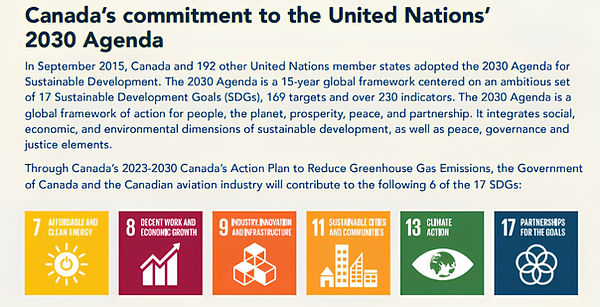
The year 2025 marked Canada as two-thirds of its way through the 15-year commitment established in 2015 between Canada and the United Nations (UN). The 2030 Agenda is a plan with ambitious goals to develop sustainable communities globally and promote innovations aimed to mitigate climate change risks on the planet.
Canada’s climate action plan from 2022 to 2030 offers a framework for Canadian airline industry operators to reduce greenhouse gas emissions (GHG), design innovative technology, and promote sustainable operations by 2030. In Canada, the aviation industry contributes almost 4% to the nation’s transportation-related GHG emissions (Transport Canada, 2023).
Since 2005, Transport Canada notes that total air traffic has increased, but in recent years, many innovations and initiatives by industry actors have helped to slow the increase of emissions. According to Climate Action Tracker, emission levels could be reduced significantly, even back to those of 2005, by the year 2050 if actors in the industry innovate and adhere to the goals of the climate action plan stated above.
What are carbon offset credit systems, and how are they used in aviation?
The aim of carbon offset credit systems (COCS) is to promote sustainable design and innovation in industries where production and/or operations emit large amounts of GHGs into the atmosphere. Consumers and corporations invest in carbon credits as a way to offset their carbon footprint, in order to help to invest in research and development in a variety of industries. These industries include but are not limited to carbon-capture projects, sustainable development projects to protect and conserve nature spaces, and tree-planting initiatives are commonly known forms of offset projects aviation companies have participated in before.
Sustainable research and development in the aviation industry is partially funded through COCS, and leads to more efficient and environmentally-friendly on-ground and in-air processes. This helps industry leaders to produce more fuel-efficient technology and design innovative routing processes. For example, Air Canada has established a $50 million research and development investment fund to promote innovative technologies in the industry, “such as sustainable aviation fuels (SAF), as well as new aircraft and carbon reductions and removals,” according to Air Canada’s Leave Less Climate Ambition Plan (Air Canada, 2025).
Public perception and regulatory drivers
Academic researchers, journalists, and media TV hosts have been critical of the concept of COCS and their effectiveness (Chung, 2019; Last Week Tonight, 2022). Research in April 2025 by the Royal Aeronautical Society (RAeS) into public attitudes on decarbonising aviation found that public perception is a factor driving the focus on the impact commercial aircraft and the air travel industry’s operations have on the environment. Of the 2000 respondents, aged between 16-75, 58% stated a belief that aviation caused more environmental damage than auto, rail, or boat emissions (Harrington, 2025).
Governments and international non-governmental organizations (NGOs) have been compelled to regulate and promote sustainable practices and production methods in aviation in recent decades based on the perceived impact air travel and private jets have on global GHG emissions.
In the US, commercial airlines contribute just over:
-
2% of GHG emissions.
-
This translates to 8% of the nation’s overall transportation emissions (Brueckner et al., 2023).
Regardless of these numbers, the public’s perception of a larger impact makes it a concern for the industry and officials to acknowledge (Brueckner et al., Pp. 1-2. 2023). Furthermore, Brueckner noted that the rising popularity of electric vehicles and other alternative methods of power in the auto industry will make the aviation industry become a more prominent contributor to the overall transport emissions in the years to come.
Having collective corporate initiatives like The Canadian Council for Sustainable Aviation Fuels (C-SAF) is positive, but will not make a substantial change in the short-term. The Carbon Offsetting and Reduction Scheme for International Aviation (CORSIA) initiative offers a way to certify biofuel producers and traders. They monitor and report on the reductions of emissions from the international aviation companies (SGS, 2024) . It’s one way that the International Civil Aviation Organization (ICAO) member countries, including Canada, work towards carbon-neutral growth for international aviation from 2020 onwards.
Internationally, there are regulations in place based on the UN’s Sustainability Developmental Goals (SDGs) and initiatives such as CORSIA, which aim to support industry reduction efforts through technological innovations, improvements to air and ground operations, and Sustainable Aviation Fuels (SAFs) to meet the ICAO’s goals. Canada uses these frameworks and schemes to design their regulations regarding aviation industry technological innovations and offset projects.
Criticism and controversies
Regulations require offset projects to be audited by third-party “certifiers”, but the effectiveness of carbon offsets have constantly been “cast into doubt” (Murphy, 2024). In 2021, The Guardian and Greenpeace joined in an investigation of Verra, the largest third-party certifiers. The joint investigation studied “10 forest protection projects that had been certified by Verra” (Murphy, 2024) and found that many calculations were incorrect. In Murphy’s 2024 UBC School of Law article it is reported that the system used for calculating the program’s effectiveness produced inflated results, thus obscuring the true outcome of the offset projects. In 2023, Verra was again investigated by the Guardian, revealing “90% of offsets approved did not represent real reductions in emissions” (Thompson, 2024). These recent examples show how low standards for transparency and lack of regulations impact support for COCs and their legitimacy as truly offsetting the GHG emissions by large corporations.
In one Senegal-based offset project, Thompson discovered that communities impacted by the replanting project were paid “10,000 francs ($22) per hectare restored. This amounts to just 5.2 percent of the total $4.4-million project budget” (Thompson, 2024). When such a small percentage of the budget for the project is going to the communities labouring to ensure the project is successful, what is the other 94% going towards?
It could be that third-party certifiers are quite expensive. Thompson stated this when they said, “Verification and auditing is one of the biggest expenses of carbon credits.” The dismal news is that the high costs of auditing don’t appear to ensure positive results. Thompson also highlighted a study of 2000 audits showing that only 12 percent of projects had GHG reductions.
Airline-specific examples — AC “Leave Less” and WJ Carbon Calculator
How have Canada’s two largest airlines—Air Canada (AC) and WestJet (WJ)— reacted to address carbon reduction efforts and utilize offset systems?
AC partners with CHOOOSE in ambitious plan
In September 2022, with global climate technology company CHOOOSE, AC established their carbon offset program (Cision, 2022). The program aims to reduce GHG emissions from aviation operations by 20% by the year 2030. As well, to bring down the GHG emissions of their ground crew operations by 30% by 2030, too.
Customers can offset their CO2 emissions upon purchase of a ticket for their flight. The CHOOOSE platform estimates GHG emissions for the customer's flight and gives them the choice to offset their emissions. Current offset projects AC align with the UN SDGs, with projects promoting forestry projects in Haida Gwaii, forest management and mangrove ecosystem projects in South America and Asia, and clean energy programs in India.
One example of a positive carbon offset project supported by AC is the Great Bear Rainforest offset program, supported by AC and CHOOOSE is the world’s largest indigenous-led forest-based carbon offset program in Canada. Climate Analytic’s authors state, “protecting and restoring the forests is both essential to mitigating emissions and supporting forest ecosystem services and biodiversity” (Great Bear Carbon, 2025). The money made from offsets has helped the project and community in lieu of logging revenues as well.
Establishing a $50 million research and development investment fund to promote innovative technologies in the industry, “such as sustainable aviation fuels, as well as new aircraft and carbon reductions and removals,” according to the Leave Less Climate Ambition Plan.
WestJet’s Consumer Carbon Credits
Major competitor and Canada’s second-largest aviation company, WJ, announced that by “incorporating newer, more fuel-efficient aircraft and optimizing flight routes,” WestJet reduced fuel emissions in 2023 by “11%.” This is one recent example of how they are aiming to achieve net-zero goals as a company by 2050. As a consumer, one can purchase carbon credits to offset their emissions when flying.
Through WJ’s Carbon Calculator, a round-trip to Toronto from Vancouver would emit 1.01 tonnes of carbon emissions. A consumer is offered the ability to offset their emissions for $28. By purchasing these credits, a consumer becomes an investor in an offset project in Newfoundland and Labrador, the first of its kind provincially.
Launched in March of 2018, the project promises that all revenues from the credits are split “50/50 with Stephenville, Appleton, and Glenwood” (Econext, 2025). These municipalities will both benefit from the conservation of the land and the reduction of methane and other GHG emissions but, economically too as shareholders in the credits’ revenue. Wetland Treatment Solutions (WTS), report that 50% of revenue from the Stephenville and the Appleton/Glenwood wastewater facilities go toward operational costs thus reducing the price of operations for the community. Furthermore, WTS report the other half of revenue goes “to reduce our study work and the cost of our future wetlands, thus putting 100% of all Carbon Offset funds back into wetland projects” (Wetlands Treatment Solutions, 2025).
More agreements like this can produce positive projects that benefit communities, along with corporations involved. This could spur on more sustainable industrial projects, even if they cost more than the less environmentally friendly options.
Conclusion: The limits of offsets as a standalone solution
COCs are a useful concept to promote sustainable and innovative projects through a market-based solution. But without transparency on the level of third-party actors that audit and operate the offset projects and pressure from governments to showcase significant positive results, it will only be a band-aid solution and cannot be the endgame to reducing GHG emissions in any industry.
Once heralded as a market-based climate solution, COCS were supposed to solve the impacts of large GHG emitters. But growing scandals, substandard results, and skeptical consumers are increasingly forcing governments and airline industry leaders to look further beyond just carbon credits.
Even Chooose says that offset programs alone won’t work, but as a supplement to emissions and in tandem with innovative technological advancements in the commercial airline industry, they are a useful tool to promote sustainable designs in the interests of the planet’s long-term health. These efforts are expensive, under the current economic system, investors and corporate actors will not organize to create sustainable fuels or more efficient aircraft without regulatory and consumer demand for sustainable technologies and practices in the industry.
References
Air Canada.(2025, June 26). Leave Less. Air Canada.
https://leaveless.aircanada.com/ca/en/leave-less.html/leave-less.html
Brueckner, J. K. and Kahn, M. E. and Nickelsburg, J. (2023). How Do Airlines Cut Fuel Usage,
Reducing Their Carbon Emissions?. IZA Discussion Paper No. 16189. https://ssrn.com/abstract=4464603
Carbonzero. (2025). Carbonzero Calculator. https://app.carbonzero.ca/index/westjet
Chung, E. (2019, February 8). Carbon Offsets: Worth Buying to Fight Climate Change?. CBC.
https://www.cbc.ca/news/science/faq-carbon-offsets-1.5008339
Cision. (2022, September 27). Air Canada Introduces CHOOOSE as New Carbon Offset Partner.
CNW Group LTD. https://www.newswire.ca/news-releases/air-canada-introduces-chooose-as-new-carbon-offset-partner-852479340.html
Climate Action Tracker. (2025). Policies & Action. Climate Action Tracker.
https://climateactiontracker.org/countries/canada/policies-action/
Econext. (2018, April 2). NEIA Celebrates the First Carbon Credits to be Generated, Verified, and
Sold in Newfoundland and Labrador. NEI Association Inc. https://econext.ca/neia-celebrates-the-first-carbon-credits-to-be-generated-verified-and-sold-in-newfoundland-and-labrador/
Great Bear Carbon. (2025, January 10). How carbon finance is seeding new hope for northern
forests. https://www.greatbearcarbon.ca/post/how-carbon-finance-is-seeding-new-hope-for-northern-forests
Harrington, T. (2025, April 11). RAeS study shows public concern about aviation emissions, but
unwillingness to pay more for solutions. Green Air News.
https://www.greenairnews.com/?p=7118
Last Week Tonight with John Oliver. (2022, August 21). Carbon Offsets: Last Week Tonight with John Oliver (HBO) [Video]. Youtube. https://youtu.be/6p8zAbFKpW0?si=ZGm0PS_VVL-UaZyd
Murphy, T. (2024, August 5). Off the Mark: Time for Canadian Airlines to Transition Away from Carbon Offsets?. Peter A Allard School of Law, University of British Columbia.
https://allard.ubc.ca/about-us/blog/2024/mark-time-canadian-airlines-transition-away-carbon-offsets
SGS SA. (2024). ISCC PLUS, ISCC EU & CORSIA.
Thompson, J. (2024, July 16). The Social Cost of Carbon Credits. Hakai Magazine.
https://hakaimagazine.com/features/the-social-cost-of-carbon-credits/
Transport Canada. (2025, June 17). Canada's Aviation Climate Action Plan. Government
of Canada. https://tc.canada.ca/en/corporate-services/policies/canada-s-aviation-climate-action-plan
Transport Canada. (2025, October 6). Greenhouse Gas Emissions. Government of
WestJet. (2024, March 20). WestJet Achieves Significant Reductions in Aircraft Emissions.
Westjet media room. https://westjet.mediaroom.com/2024-03-20-WestJet-achieves-significant-reductions-in-aircraft-emissions
Wetlands Treatment Solutions. (2025). Carbon-Neutral Wastewater & Constructed Wetlands
Canada.