How Canada’s Electricity Landscape Will Evolve from 2026 to 2035
June 14, 2026
By Lucas Bettle
Canada currently faces pressure from its increasing demand for electricity and its net-zero emissions goals. The country’s electricity landscape is set to undergo major changes from 2026 through 2035 as it attempts to balance both of these needs. Many major projects are already planned, with over $160 billion in committed investments to new projects throughout the electricity generation sector. However, are the steps being taken today moving the country in the right direction for a sustainable future?
Canada’s Current Electricity Generation Landscape
Canada’s current energy landscape can be evaluated in two different ways.
-
Installed capacity refers to the total power available in megawatts (MW). However, generating stations operate below nameplate capacity to allow for some buffer, and actual generation varies seasonally and throughout the day with demand.
-
Electricity generation is the total energy produced in terawatt-hours (TWh).
As of 2024, Canada had a total installed capacity of 156,388 MW (Statistics Canada, 2025). In 2023, total generation was 622 TWh (Natural Resources Canada, 2025). The figures below break down capacity and generation by source.
Hydroelectric generation is the country’s largest source of electricity and the primary driver of Canada’s renewable energy. Other renewables, such as wind and solar, are much less prominent, with conventional sources such as natural gas and nuclear having larger shares.
Major Electricity Projects from 2026 to 2035
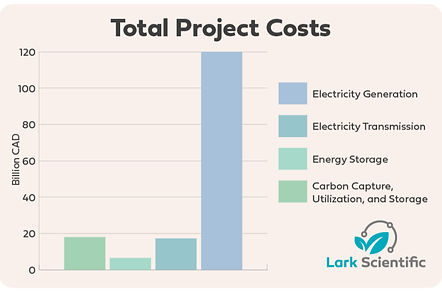
Canada’s electricity landscape is changing rapidly, with 77 major projects planned or currently underway. Together, these projects account for an investment of $162 billion and cover electricity generation, electricity transmission, energy storage, and carbon capture and storage.
The figures below show the number of individual projects and the total cost across these categories.
Planned electricity generation projects will increase Canada’s generating capacity by 20,276 MW. The largest planned additions include major nuclear and natural gas projects, along with a high number of smaller-scale solar installations. The figures below show the breakdown of planned electricity projects by capacity and by cost.
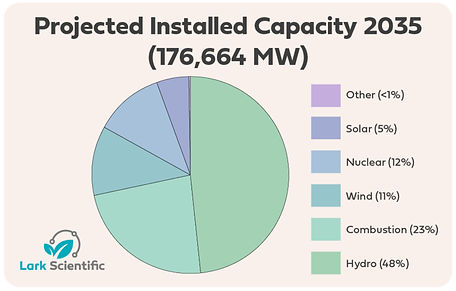
These projects will change the overall distribution of electricity generation sources in Canada. With relatively fewer new projects, hydro may start to lag behind, while both nuclear and solar are poised to increase their share. The figure below shows what Canada’s installed generating capacity will look like if all of these projects are completed by 2035.
Solar Power Projects Quickly Growing in Number
With more than 25 major projects underway and $5.7 billion in investment set to add 4,000 MW of capacity, solar power is quickly advancing in Canada. Many of the largest such projects are based in Alberta, with the 556 MW Homestead Solar Project planned for 2027 (Choi, 2025) and the 450 MW Aira Solar Project set to start producing power in 2026 (Government of Alberta, 2025).
Large-Scale Wind Farm Projects Underway
There are 10 major wind power projects across Canada set to add 2,719 MW of capacity with $6.9 billion in investments. The Webster’s Corner Wind Farm in Nova Scotia is planned to produce 500 MW by 2028, and will also be paired with a green hydrogen production facility (Bear Head Energy, 2025). Another major wind farm in Des Neiges, Quebec, is set to come online in 2026, producing 400 MW (Boralex, 2025).
Relatively Moderate Growth in Hydroelectricity
Hydroelectric power accounts for 57% of Canada’s electricity generation, with the country being the third-largest hydropower generator behind only China and Brazil (Natural Resources Canada, 2025). There are 6 major projects planned and underway in this area, with $27.8 billion in investment going toward 2,415 MW. Despite being the second-highest investment behind nuclear, planned new hydro capacity ranks behind every source except for bioenergy, geothermal, and tidal.
New hydroelectric development carries a very high cost due to the scarcity and remoteness of suitable sites. The $25 billion Gull Island Generating Station in Labrador is planned to be completed by 2034 and will produce 2,250 MW as a cooperative venture between Quebec and Newfoundland (Hydro Quebec, 2025).
Continued Growth in Natural Gas Electricity Generation
Seemingly running against Canada’s environmental commitments toward green and renewable energy, there are currently six major natural gas electricity generation projects planned or underway, accounting for $11.2 billion in investments and adding 4,159 MW of capacity.
Alberta is home to most of these projects, including the $4.5 billion, 1,864 MW Greenlight Electricity Centre (Kineticor, 2025). This and other projects claim that their facilities will be built with carbon capture functionality to reduce emissions impact, but the efficacy of those measures remains to be seen.
Major Investments in New Nuclear Projects
Canada’s nuclear energy sector is also seeing a surge, with 4 major projects drawing more than $67 billion in investments and planning to add 6,400 MW of capacity. This makes nuclear the largest source in terms of both investment and capacity.
The most prominent project here is the proposed Peace River Nuclear Power Project (Government of Canada, 2026). The project would see a full-scale $40 billion, 4,800 MW nuclear plant built near Peace River, Alberta, by 2035. Projects elsewhere are focusing on small modular reactor (SMR) technology, such as the Darlington SMR Project in Ontario, which plans to install 4 SMRs by 2030 (Ontario Power Generation, 2025).
Other Renewables Being Explored
There are also projects focusing on less widespread electricity generation options. Geothermal is a prime example, with 3 major projects proposed to produce 67 MW with an investment of $556 million. The Rainbow Lake Geothermal Project is set to come online by 2028 and generate 50 MW (Geothermal Canada, 2025), making it the largest such project in Canada.
Bioenergy is another area being developed, with 3 major projects accounting for $672 million in investment. The largest such project is the conversion of New Brunswick’s 476 MW Belledune coal generation plant to instead generate power by burning wood biomass (NB Power, 2025). This type of conversion to use renewable fuels is an important part of meeting Canada’s goal to phase out coal-fired power plants by 2030 (Canada Energy Regulator, 2024).
Tidal energy is seeing more attention, but it is still an immature technology. The Uisce Tapa In-Stream Tidal Energy Project is the only major project in this area and is planned to produce 9 MW in the Bay of Fundy off Nova Scotia, with an investment of $117 million and no set completion date (Tethys, 2025).
Increasing Canada’s Energy Storage Infrastructure
Electricity generation isn’t the only area of focus for Canada’s energy landscape. Energy storage is set to play a key role in the future, making it possible to rely more heavily on intermittent generation sources such as wind and solar. There are 6 major energy storage projects underway, accounting for $6.5 billion in investment and creating 47,720 MWh of storage with power output up to 2,958 MW.
Energy storage covers a variety of innovative technologies from lithium-ion batteries to compressed-air energy storage. The largest planned project is the Ontario Pumped Storage Project, which stores energy by pumping water to fill a reservoir during periods of low demand and generating hydroelectric power during high demand (Government of Ontario, 2025). It will provide output of up to 1,000 MW, and store enough energy to operate at full capacity for up to 11 hours.
Major Electrical Transmission Projects Planned
Achieving Canada’s net-zero goals requires transitioning toward greater electrification, both in remote communities and established cities. The country is investing in significant electrical transmission infrastructure, with 10 major projects accounting for $17.4 billion and adding up to 4,123 km of transmission lines.
The Kivalliq Hydro Fibre Link is one of these projects, a 1,200 km power and communications line that will connect Nunavut and Manitoba (Nukik Corporation, 2025). This is significant as it is the first electrical grid connection to Nunavut, which currently relies on essentially 100% local diesel fuel for electricity generation (Canada Energy Regulator, 2025).
Investment in Carbon Capture, Utilization, and Storage
Canada still has a significant reliance on fossil fuels, primarily natural gas. As such, there is significant investigation into and development of carbon capture, utilization, and storage to mitigate emissions from these sources. There are currently 3 major projects underway in this area, accounting for $17 billion in investment and promising a carbon capture, utilization, and storage capacity of 2,660,000 tonnes of CO2 per year.
The Pathways Alliance Carbon Capture Storage Hub project accounts for nearly all of that investment, planning to provide a 400 km pipeline and underground sequestration for 1,500,000 tonnes of CO2 per year from the Alberta oilsands (Government of Alberta, 2025).
Is Canada Advancing Toward Its Electricity Goals?
Major investments are being made to develop Canada’s electricity generation capacity and accompanying infrastructure. While trends in solar and nuclear power appear promising and new areas such as geothermal and tidal are being explored, the country also continues to make major investments in natural gas. Based on the roadmap of planned projects laid out from here to 2035, current priorities may be driven more by increasing demand than by Canada’s net-zero goals.
While planned nuclear projects lead the pack with 6,400 MW, planned natural gas projects outpace solar, wind, and other renewables at 4,159 MW. Energy storage investments amounting to $6.5 billion and planned transmission infrastructure investments totaling $17.4 billion do point to a promising future grid, but this is only the case if clean generation follows suit. Even as renewables continue to rise, it seems like the country isn’t ready to truly commit to abandoning fossil fuels in electricity generation.
References
Bear Head Energy. (2025). Our Project. Retrieved from Bear Head Energy.
Boralex. (2025). Des Neiges - Secteur Sud MRC de La Côte-de-Beaupré. Retrieved from Boralex.
Canada Energy Regulator. (2024). Market Snapshot: Canadian coal-fired electricity generation is rapidly being replaced by low and non-emitting energy sources. Retrieved from Canada Energy Regulator.
Canada Energy Regulator. (2025). Renewable Energy in Canada Current Status and Near-Term Developments in Nunavut. Retrieved from Canada Energy Regulator.
Choi, T. (2025). Greenwood acquires Canada's second-largest solar development. Retrieved from SustainableBIZ.
Geothermal Canada. (2025). Rainbow Lake Geothermal Project. Retrieved from Geothermal Canada.
Government of Alberta. (2025). Aira Solar Project. Retrieved from Major Projects Alberta.
Government of Alberta. (2025). Pathways Alliance Carbon Capture Storage Hub (Phase 1). Retrieved from Government of Alberta.
Government of Canada. (2026). Peace River Nuclear Power Project.
Government of Ontario. (2025). Ontario Starting Pre-Development Work for Pumped Storage Project in Meaford. Retrieved from Government of Ontario Newsroom.
Hydro Quebec. (2025). Churchill River Study and Hydroelectric Developments . Retrieved from Hydro Quebec.
Kineticor. (2025). Greenlight Electricity Centre. Retrieved from Kineticor.
Natural Resources Canada. (2025). Energy Fact Book 2025-2026.
Natural Resources Canada. (2025). Major Energy and Natural Resources Projects Inventory.
Natural Resources Canada. (2025). Natural Resources Major Projects Planned or Under Construction 2024 to 2034.
NB Power. (2025). Belledune Clean Fuel Project. Retrieved from NB Power.
Nukik Corporation. (2025). Annual Summary Report Kivalliq Hydro-Fibre Link.
Ontario Power Generation. (2025). Small Modular Reactors. Retrieved from OPG.
Statistics Canada. (2025). Installed plants, annual generating capacity by type of electricity generation.
Tethys. (2025). Uisce Tapa Project. Retrieved from Tethys.