Canada is Losing the Global Sustainable Aviation Fuel (SAF) Race
September 9, 2026
By Denis Koshelev
-
Canada, despite abundant feedstocks like canola and forestry residues, lags behind the US and Europe in developing a sustainable aviation fuel (SAF) industry.
-
Canada’s strategic canola supply is underutilized for high-value energy uses like SAF, as policy and trade challenges limit domestic industry growth.
-
Canada consumes billions of litres of jet fuel annually but relies on imports for lower-carbon options and has no commercial SAF manufacturing facilities.
-
British Columbia is the only province with dedicated SAF mandates.
-
Canada is sitting on an aviation goldmine, but watching others stake the claim. With some of the world’s best feedstocks for low‑carbon jet fuel — canola from the Prairies and vast stores of forestry residues — Canada should be shaping the future of sustainable aviation, not trailing it. Yet while the U.S. and Europe have unleashed clear mandates and rich incentives to accelerate sustainable aviation fuel, Canada has leaned on broad, cautious regulation and only recently introduced modest supports, raising the prospect that Canadian biomass will power foreign skies instead of catalyzing a homegrown sustainable aviation fuel (SAF) industry.
Global SAF race
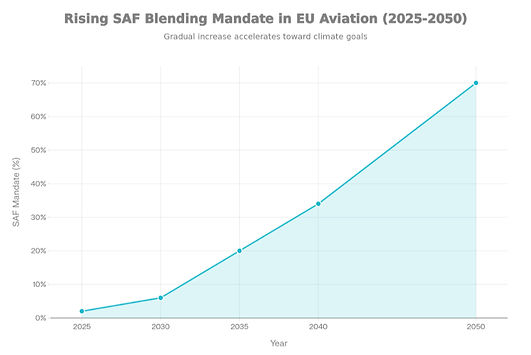
Worldwide SAF production is growing quickly, but still represents less than 1% of total jet fuel demand. In 2024, output reached 1 million tonnes (0.3% of the global jet fuel market), double the 2023 production, with expectations of reaching 2.1 million tonnes (0.7% of the market) (International Air Transport Association [IATA], 2024). The European Union has turned this small base into a powerful investment signal by mandating that fuel suppliers at EU airports blend at least 2% SAF starting this year, increasing to 6% in 2030 (including 1.2% synthetic e-SAF) and ramping toward 70% by 2050, with specific sub-targets for synthetic e-SAF to encourage more advanced technologies. (Syntholene Energy, 2024).
In the United States, federal law initially created a dedicated SAF tax credit of at least $1.25 per gallon, rising to as much as $1.75 per gallon depending on lifecycle emissions performance through 2024, followed by a technology-neutral clean fuel production credit (Section 45Z) that was designed to continue supporting SAF from 2025 onward. However, H.R. 1 (the “One Big Beautiful Bill Act,” a broad federal reconciliation package signed into law on July 4, 2025), passed on July 4, 2025, slashed the SAF premium under 45Z from $1.75 to $1.00 per gallon — a reduction that raised concerns across the industry about the viability of planned projects. In response, bipartisan legislation introduced in December 2025 (the SAF Act) seeks to restore the full $1.75-per-gallon credit and extend it through 2033, reflecting both the political volatility of U.S. biofuel policy and the continued strong support from aviation and agriculture sectors for dedicated SAF incentives (Ryan, 2025). Regardless of the credit's final level, these federal incentives can still be stacked with Renewable Fuel Standard credits and state programs such as California's low-carbon fuel standard, creating a multi-layered support structure that — despite current uncertainty — remains more explicit and lucrative than Canada's approach. Put simply, even with policy flux, U.S. airlines and fuel producers can plan against dedicated SAF-specific mechanisms and bankable per-gallon incentives, whereas Canadian developers face generic biofuel programs with no comparable SAF-targeted support, meaning capital continues to flow to U.S. markets first (Starr & Lewis, 2025; Swanson, 2024).
By contrast, Canada consumes billions of litres of jet fuel each year but still has no commercial SAF manufacturing facilities, with domestic demand for lower-carbon jet fuel currently met almost entirely by imports (Allan et al., 2023). Canadian air carriers consumed 8.0 billion litres of turbo fuel in 2023 (Statistics Canada, 2025), while pure SAF projects remained stuck at the development stage. Several companies have announced biofuels facilities that could produce at least 500 million litres of SAF in Canada by 2030, but most of these announced facilities have not yet reached final investment decisions.
British Columbia is the lone Canadian jurisdiction to adopt an explicit SAF implementation mandate, requiring jet fuel at its airports to include at least 1% renewable content in 2028, rising to 2% in 2029 and 3% in 2030, alongside a staged carbon-intensity reduction requirement (Life Cycle Associates, 2024).
The province itself acknowledges that no commercial-scale SAF plant operates anywhere in Canada. (British Columbia Chamber of Commerce, 2025). Federal climate policy has focused instead on the Clean Fuel Regulations, which force gasoline and diesel suppliers to reduce lifecycle carbon intensity and create a credit market where low-carbon fuels can earn tradable credits on a voluntary opt-in basis, but these rules do not set a dedicated SAF blend mandate nor do they offer a SAF-specific production credit comparable to those in the U.S. or Europe (Allan et al., 2023).
Canola: underused strategic asset
This sluggish policy environment contrasts sharply with Canada’s position as one of the world’s dominant producers of canola, a preferred feedstock for HEFA‑type renewable diesel and SAF technologies because it is energy‑dense, has well‑characterized agronomy, and can achieve relatively low lifecycle carbon intensity under clean fuel standards. In 2024, Canadian farmers seeded about 22 million acres of canola and harvested roughly 17.8 million tonnes, with production concentrated in Saskatchewan, Alberta and Manitoba, and domestic crushing capacity already handling more than 14 million tonnes per year to produce nearly 5 million tonnes of oil.
At the same time, Canada is being pushed by trade disputes to reorient its canola value chain: China has imposed steep anti‑dumping tariffs on Canadian canola seed and has also targeted oil and meal imports, while new export infrastructure is coming online to diversify markets, all of which increases the strategic appeal of diverting a share of canola oil to high‑value energy uses such as renewable diesel and SAF (Canola Council of Canada, n.d.).
Policy makers in Ottawa have begun to respond, but mostly at the level of generic biofuels rather than a focused SAF industrial strategy. In 2025, the federal government announced a new biofuel production incentive program worth 372 million Canadian dollars, framed explicitly as a way to help canola and agriculture producers adjust to U.S. and Chinese trade pressures and to make domestic biofuel production more competitive — though notably, the program does not specifically target SAF production.
This sits alongside the broader 1.5‑billion‑dollar Clean Fuels Fund and new clean‑economy investment tax credits designed to encourage low‑carbon fuel plants. These measures should improve the economics of canola‑based renewable diesel and SAF projects at the margin, but developers still point out that the per‑litre value of Canadian support remains weaker and less predictable than the stacked package available south of the border, meaning Canadian canola and canola oil are likely to keep flowing into U.S. refineries and export markets rather than anchoring a domestic SAF industry unless the incentive gap closes. (Shepherd, 2025).
Forestry residues: a parallel missed opportunity
Canada’s forests offer a second, arguably even more strategic, SAF advantage in the form of residues from harvesting, milling and fire‑risk fuel treatments (forest management practice designed to reduce the amount and continuity of flammable vegetation — called "fuels" — in order to lower the risk of catastrophic wildfires). Yet most of this biomass still goes to low‑value uses such as traditional pulp and paper and pellet exports, or is left in the bush.
Canada is already one of the world’s largest exporters of wood pellets, with the majority shipped overseas, confirming that the country can mobilize huge volumes of forest residues but also highlighting that the value is being captured as low‑margin solid fuel rather than as advanced drop‑in aviation fuel. (Natural Resources Canada, 2024).
Recent research on integrating wildfire fuel management with bioenergy shows how big the untapped resource is: one national study estimated that fuel‑treatment biomass in British Columbia alone could amount to around 2.5 million oven‑dry tonnes per year, and similar analyses suggest that many remote, diesel‑dependent communities could supply their own energy needs by harvesting less than 1% of surrounding high‑risk forest biomass annually, implying a vast theoretical feedstock pool for higher‑value biofuels if appropriate supply chains and safeguards were put in place. (Mansuy et al., 2025; Natural Resources Canada, 2025).
Federal and provincial programs do support forest bioenergy in general, including the Clean Fuels Fund, the Forest Innovation Program, and the Investments in Forest Industry Transformation initiative, which collectively finance projects that turn forestry residues into bioheat, renewable gas, or advanced biofuels.
Yet most of the actual deployment documented in Canada’s 2024 bioenergy review remains in heat and power — such as biomass‑fired boilers, district heating in rural and Indigenous communities, and pellet production — rather than in liquid transport fuels, and there is no clear, bankable policy signal that channels this residual biomass toward SAF advanced pathways like
gasification‑Fischer–Tropsch or alcohol‑to‑jet on the scale now being contemplated in Europe (Pelkmans, 2024; Regulation [EU] 2023/2405, 2023).
Without a targeted combination of long‑term SAF mandates, dedicated production or investment credits, and perhaps contracts‑for‑difference to bridge the persistent price gap between SAF and fossil jet fuel, Canada risks watching its forest residues continue to leave the country as low‑value pellets while foreign developers capture the technology learning and intellectual property associated with advanced aviation fuels (National Airlines Council of Canada, 2024).
Policy choices and the risk of squandering advantage
Canada’s official climate plans recognize that low‑carbon fuels will have to provide a large share of the country’s energy use by 2050, but so far the focus has been on generic greenhouse‑gas reductions across all fuels rather than on building a specific SAF value chain. This narrow approach risks a double failure: Canada is not only failing to capitalize on its massive agricultural and forestry biomass but is also ignoring the competitive edge offered by its clean hydroelectric grids, which could position the nation as a leader in the production of hydrogen-based synthetic “e‑fuels” — the very technology the EU is already mandating for the post-2030 aviation market.
Provinces like British Columbia are out in front with SAF blend and carbon‑intensity requirements for jet fuel, but industry and business groups there already warn that the province may have to delay or soften its targets because there is no domestic SAF production and global supplies are too tight and expensive, highlighting how difficult it is for a small market to overtake larger jurisdictions that have aligned mandates with supply‑side subsidies. If Canada continues on its current path, the most likely outcome is that canola farmers and forest companies continue to ship raw or lightly processed feedstock abroad, where U.S. and European plants convert it into SAF that is then imported back or used to meet foreign airlines’ obligations, effectively exporting both jobs and technology learning while paying a premium to buy back the finished product.
The alternative would be to treat SAF as a strategic clean‑growth industry, much as the U.S. and EU have done, by pairing long‑term, rising blend mandates with robust, predictable production incentives and clear rules on lifecycle carbon accounting for key Canadian feedstocks such as canola and forest residues. (Bracewell LLP, 2025)
That could include scaling up the new federal biofuel production incentive into a SAF‑specific per‑litre credit, making full use of clean‑technology investment tax credits for SAF refineries, orienting a portion of the Clean Fuels Fund and provincial programs explicitly toward aviation fuels, and giving airlines regulatory certainty through a national SAF target that complements international commitments made through bodies like the International Civil Aviation Organization. Without a coordinated federal SAF strategy by mid-2026, Canada risks becoming a feedstock supplier to foreign SAF industries rather than building its own decarbonization capacity and clean-tech jobs.
References
International Air Transport Association. (2024, December 10). Disappointingly slow growth in SAF production [Press release]. https://www.iata.org/en/pressroom/2024-releases/2024-12-10-03/
Syntholene Energy. (2024, December 12). SAF production must expand to meet 6% mandate by 2030, says EASA. https://syntholene.com/saf-production-to-meet-6-mandate-by-2030-says-easa/
Starr, R., & Lewis, J. (2025, October 16). H.R. 1 expands 45Z clean fuel production credit for conventional biofuels while cutting sustainable aviation fuel tax credit. Clean Air Task Force. https://www.catf.us/2025/10/h-r-1-expands-45z-clean-fuel-production-credit-for-conventional-biofuels-while-cutting-sustainable-aviation-fuel-tax-credit/
Swanson, A. (2024, February 26). Is sustainable aviation fuel the future of ethanol? farmdoc daily, 14(39). Department of Agricultural and Consumer Economics, University of Illinois at Urbana-Champaign. https://farmdocdaily.illinois.edu/2024/02/is-sustainable-aviation-fuel-the-future-of-ethanol.html
Allan, B., Goldman, J., & Tauvette, G. (2023). The C-SAF roadmap: Building a feedstocks-to-fuels SAF supply chain in Canada [Executive summary]. Canadian Council for Sustainable Aviation Fuels. https://transitionaccelerator.ca/wp-content/uploads/2023/07/CSAF_Roadmap_Executive_Summary.pdf
Statistics Canada. (2025, January 17). Annual civil aviation statistics, 2023. https://www150.statcan.gc.ca/n1/daily-quotidien/250117/dq250117c-eng.htm
Life Cycle Associates. (2024). British Columbia Low Carbon Fuels Regulation (2024). https://www.lifecycleassociates.com/services/british-columbia-low-carbon-fuels-regulation/
British Columbia Chamber of Commerce. (2025). Sustainable aviation fuel takes flight. https://bcchamber.org/policy-search/sustainable-aviation-fuel-takes-flight-2025
Canola Council of Canada. (n.d.). Canola production statistics. https://www.canolacouncil.org/markets-stats/production/
Shepherd, J. (2025, August 13). U.S. policy impacting biofuel potential in Canada. Farm Credit Canada. https://www.fcc-fac.ca/en/knowledge/economics/us-policy-impacting-biofuel-potential-canada
Natural Resources Canada. (2024, December 20). Bioenergy systems. https://natural-resources.canada.ca/energy-sources/renewable-energy/bioenergy-systems
Mansuy, N., Buss, J., Hirsch, K. et al. Integrating fire-smart fuels management with bioenergy benefits remote and Indigenous communities in Canada. Commun Earth Environ 6, 358 (2025). https://doi.org/10.1038/s43247-025-02313-1
Natural Resources Canada. (2025, July 28). Simply Science in Seconds: A win-win for clean energy and wildfire mitigation. https://natural-resources.canada.ca/stories/simply-science/simply-science-seconds-win-win-clean-energy-wildfire-mitigation
Pelkmans, L. (Ed.). (2024). Implementation of bioenergy in Canada – 2024 update (IEA Bioenergy Country Reports). IEA Bioenergy. https://www.ieabioenergy.com/wp-content/uploads/2024/12/CountryReport2024_Canada_final.pdf
National Airlines Council of Canada. (2024, February 6). Aviation industry calls on Liberal government to incentivize Canadian production of Sustainable Aviation Fuels in Budget 2024. https://airlinecouncil.ca/aviation-industry-calls-on-liberal-government-to-incentivize-canadian-production-of-sustainable-aviation-fuels-in-budget-2024/
Regulation (EU) 2023/2405 of the European Parliament and of the Council of 18 October 2023 on ensuring a level playing field for sustainable air transport (ReFuelEU Aviation), Official Journal of the European Union L 2023/2405 (2023). https://eur-lex.europa.eu/legal-content/EN/TXT/PDF/?uri=OJ:L_202302405
Bracewell LLP. (2025, May 21). Sustainable aviation fuel: An overview of the current regulatory landscape in the UK, EU and USA. https://www.bracewell.com/resources/sustainable-aviation-fuel-an-overview-of-the-current-regulatory-landscape-in-the-uk-eu-and-usa/
Ryan, M. (2025, December 10). SAF bill would restore, extend production credit. AVweb. https://avweb.com/aviation-news/saf-bill-would-restore-and-extend-credit/