How AI is Transforming Grid Management and Energy Storage in Canada
June 30, 2026
By Denis Koshelev
Canada’s electricity grid stands at a critical juncture as the country accelerates its transition toward renewable energy sources and aims for net-zero emissions by 2050. The intermittent nature of wind and solar power, combined with increasing electrification demands from electric vehicles and data centers, presents unprecedented challenges for grid stability and reliability.
Data centre electricity consumption in Canada is projected to increase 400% by 2050, with AI facilities requiring 100+ MW compared to 5-10 MW for traditional centres (NES Fircroft, 2025; Climate Institute, 2025). Canada currently has more than 230 operational data centres, with the largest clusters in Toronto, Montreal, and Vancouver, yet they currently make up only around 1% of Canadian electricity usage (NES Fircroft, 2025).
In response, the federal government has made substantial investments in artificial intelligence technologies specifically designed to manage these complexities, with a strategic emphasis on supporting Canadian-made AI solutions that position the country as a leader in clean energy innovation (Natural Resources Canada, 2025a). In this domain, artificial intelligence stands out as a revolutionary force, delivering unparalleled predictive, adaptive, and instantaneous decision-making power that far exceeds traditional optimization and monitoring approaches. (Iyaniwura & Mayaki, 2025).
Federal Investment in Canadian AI Innovation
In late 2025, Natural Resources Canada launched the Artificial Intelligence for Canadian Energy Innovation Call for Proposals through its Energy Innovation Program, marking a pivotal commitment to developing domestic AI capabilities for the energy sector (BC Bioenergy Network, 2025). This initiative aims to fund high-impact applied research, development, and demonstration projects that catalyze national expertise to develop and deploy novel Canadian-made AI solutions specifically designed to accelerate energy innovation while lowering associated costs and timeframes. The program’s three core objectives focus on developing AI solutions to reduce the cost, time, and energy consumption of traditional methods for advancing energy innovations, fostering collaboration between AI developers and energy technology innovators to promote knowledge exchange, and promoting Canadian energy data availability, accessibility, and security across the energy innovation ecosystem (University of Calgary Research Services, 2025).
This federal initiative represents a recognition that Canada possesses unique advantages in addressing grid intermittency challenges. The country’s intergovernmental collaboration, internationally respected national statistical systems, and proven capacity to build shared governance mechanisms provide a strong foundation for integrated AI-energy solutions. Canada has more than 80% of its electricity coming from low-emission sources, with hydroelectric power providing around 60% of the country’s supply, creating a strong advantage for operating low-emission data centres (NES Fircroft, 2025). However, the current fragmentation across fourteen heterogeneous digital infrastructures with divergent standards, metadata, and identifiers has historically undermined public-sector efficiency and the responsible deployment of AI systems (CIRANO, 2025). The new federal funding stream seeks to address these systemic challenges by promoting standardized, interoperable Canadian AI platforms.
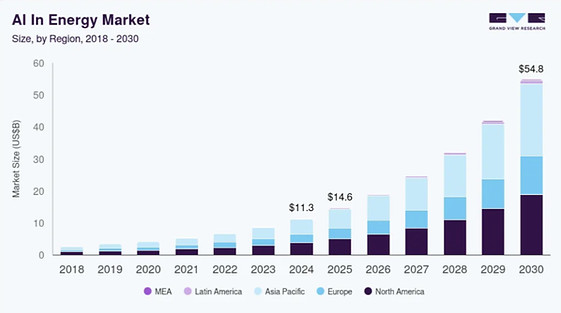
[Industry forecast from Grand View Research]
A critical dimension omitted from federal AI-energy strategies is Indigenous leadership in infrastructure development. The Mihta Askiy data centre, a joint venture between Woodland Cree First Nation (51% ownership) and Sovereign Digital Infrastructure, represents a 650 MW AI facility in Alberta that exemplifies economic reconciliation (Government of Alberta, 2025; CBC, 2025). Minister Nate Glubish described it as a “strong vote of confidence in Alberta’s AI Data Centre Attraction Strategy,” while Chief Isaac Laboucan-Avirom emphasized it “exemplifies our roles as stewards of the land, and as forward-looking leaders in innovation” (Mihta Askiy Datacenter LP, 2025). Such projects demonstrate how Indigenous data sovereignty and energy sovereignty can align with national AI objectives, creating generational value while respecting treaty rights.
Hydro Ottawa’s ODERA Program
The most prominent example of federal investment in Canadian-made AI solutions emerged on December 11, 2025, when Ministers Tim Hodgson and Evan Solomon announced $6 million in federal funding to Hydro Ottawa Limited for the Ottawa Distributed Energy Resource Accelerator program (Natural Resources Canada, 2025b). This initiative represents a comprehensive approach to addressing grid intermittency through AI-enhanced predictive analytics that accurately forecast peak demand and inform real-time balancing of electricity supply and demand (Natural Resources Canada, 2025b). The ODERA program’s innovative approach transforms customer-owned assets, including smart thermostats, electric vehicle chargers, and home batteries, into valuable, responsive grid resources, enabling the utility to proactively identify and mitigate grid constraints before they develop into systemic problems (Natural Resources Canada, 2025b).
The program serves as a pilot deployment for high-growth neighbourhoods like Kanata North in Ottawa, where rapid development has strained existing grid infrastructure. By leveraging advanced technology that combines predictive analytics with granular demand response capabilities, Hydro Ottawa can proactively address localized system needs in near real-time, fundamentally changing how utilities manage grid load by transforming distributed customer assets into actively managed grid resources (Natural Resources Canada, 2025b).
Bryce Conrad, President and Chief Executive Officer of Hydro Ottawa Limited, emphasized that ODERA represents more than a solution for immediate capacity constraints, describing it as “a scalable blueprint for integrating cleaner, smarter energy across other areas” of the utility’s service territory (Natural Resources Canada, 2025b). This scalability positions the ODERA model as potentially transformative for utilities across Canada facing similar intermittency and capacity challenges.
Minister Evan Solomon framed the investment within Canada’s broader AI strategy, stating that “AI integration is increasing productivity across numerous sectors in Canada, and we will continue to invest in innovative technologies. Our government is building AI for all and using it to improve the day-to-day lives of Canadians.” (Natural Resources Canada, 2025b)
BluWave-ai’s Grid Management Leadership
Among Canadian companies developing AI solutions for grid intermittency, Ottawa-based BluWave-ai has emerged as a particularly significant innovator. Founded in Canada in 2017, the company has built what it describes as the premier AI platform for the global energy transition, focusing specifically on driving the proliferation of renewable energy and electric transportation through work with electricity utilities, independent power producers, and electric vehicle fleet operators globally. The company’s technology stack integrates AI-driven optimization across all critical energy storage assets, built upon a substantial foundation of intellectual property, including 49 patent applications filed globally with 11 patents already granted (BluWave-ai, 2025).
In October 2025, BluWave-ai received the Grid Management Storage Award from Energy Storage Canada, specifically recognizing the company’s EV Everywhere platform being deployed with the Independent Electricity System Operator and Hydro Ottawa. This platform represents an approach to managing grid intermittency by treating electric vehicles not merely as loads on the grid but as distributed energy storage assets that can be intelligently orchestrated to support grid stability.
Vehicle-to-grid (V2G) systems are crucial for seamlessly integrating electric vehicles (EVs) into smart grids, allowing energy to flow both to and from the grid. However, optimizing V2G operations presents considerable hurdles, primarily stemming from fluctuating energy demands, grid limitations, and diverse user choices (Escoto et al., 2024). The system makes real-time decisions to optimize EV charging based on grid stress levels, energy costs, and renewable energy availability, proving that this new category of distributed storage assets can be reliably integrated into grid operations (BluWave-ai, 2025).
At the heart of V2G applications, digital twin frameworks are indispensable, enabling AI-driven systems to foster sustainable transportation and integrate seamlessly with smart grids through powerful predictive simulations. These adaptable digital twin strategies support a wide spectrum of fleet operations, ranging from optimized residential energy management and coordinated charging protocols to efficient commercial car-sharing schemes. By harnessing vehicles as distributed battery storage, V2G maximizes energy utilization, providing crucial backup power during periods of peak demand or grid disruptions (Costa & Papa, 2025).
Recently, BluWave-ai unveiled results from two years of operational deployment of the EV Everywhere platform throughout Canadian grids, demonstrating that the aggregation of electric vehicles proved approximately 55 times more capital-efficient than equivalent utility-scale battery storage. The platform has demonstrated potential to offer infrastructure deferral value ranging from $2.3 million to $7.9 million per 1,000 electric vehicles, depending on local grid conditions (Yahoo Finance, 2026). This capital efficiency advantage positions Canada as a global leader in AI-enabled grid solutions, leveraging its 80%+ low-emission electricity to attract major tech investments from Amazon, Google, and Meta seeking sustainable AI infrastructure (Evolve ETFs, 2025). These economic metrics suggest that AI-orchestrated vehicle-to-grid integration represents not merely a technical solution to intermittency but a fundamentally different economic model for grid infrastructure investment. Decentralized energy storage networks, coupled with AI-powered demand-side optimization, bolster grid resilience and significantly reduce transmission losses. However, the inherent variability of renewable energy sources presents substantial hurdles for maintaining grid stability and consistent reliability (GYAASE et al., 2025).
AI-Driven Battery Storage Optimization
Beyond vehicle-to-grid integration, Canadian innovators are developing AI solutions specifically for stationary battery storage optimization. Scale AI, a Canadian AI supply chain supercluster, funded development of an AI-driven Battery Portfolio Optimization Software platform designed to help energy storage providers make superior real-time decisions about when to charge or discharge batteries. The challenge this technology addresses is fundamental to grid intermittency management: reaching Canada’s net-zero targets will require massive expansion in battery storage capacity, yet market complexity and volatility make it difficult for operators to run these assets profitably (Scale AI, 2025). Artificial intelligence and machine learning have fundamentally transformed the way energy storage is managed. These advanced technologies facilitate real-time optimization, provide sophisticated predictive insights, and enable smarter decision-making. Specifically, reinforcement learning algorithms significantly enhance battery scheduling and optimize charge-discharge cycles, thereby reducing energy losses and prolonging battery operational life (Kumar & Divija, 2025).
The AI-powered platform analyzes market prices, grid needs, and battery health in real-time, coordinating multiple assets simultaneously and responding dynamically to maximize revenue while reducing battery degradation. A successful proof-of-concept demonstration showed up to 25 percent additional returns compared to conventional battery management approaches, suggesting substantial economic value creation beyond the immediate grid stability benefits (Scale AI, 2025). Artificial intelligence significantly boosts battery energy efficiency. This is achieved thanks to state-of-charge (SOC) and state-of-health (SOH) estimations, enabling proactive maintenance and optimizing temperature control. (Kumar & Divija, 2025).
This optimization becomes particularly critical as Energy Storage Canada’s recently published Energy Storage Market Outlook projects that as much as 37 gigawatts of long- and short-duration storage capacity will be needed to meet Canada’s energy demand between 2025 and 2050. Furthermore, to align with climate targets, dedicated Battery Energy Storage System capacity will need to rise above 12,000 megawatts by the end of this decade (BluWave-ai, 2025).
Technical Mechanisms for Managing Intermittency
The AI systems being deployed for grid intermittency management employ several interconnected technical approaches. However, these software solutions face a critical infrastructure timeline disconnect, while AI can optimize operations within minutes, transmission projects typically require close to a decade for completion, creating near-term capacity constraints that AI must bridge (IT Brief Asia, 2026). This reality makes immediate AI optimization critical for managing existing capacity amid long grid connection waitlists (Climate Institute, 2025).
Artificial intelligence significantly boosts solar energy efficiency by leveraging predictive analytics. This technology precisely optimizes photovoltaic panel angles and accurately forecasts solar irradiance, thereby enhancing performance (Mynavathi et al., 2025). Furthermore, AI’s exactitude improves grid integration, enables efficient energy scheduling, and minimizes power fluctuations, ultimately fostering greater grid stability (Adeoye et al., 2025).
Predictive analytics form the foundational layer, utilizing machine learning models trained on historical consumption patterns, weather forecasts, and real-time grid conditions to forecast demand with unprecedented accuracy (Natural Resources Canada, 2025b). These forecasts enable grid operators to anticipate rather than merely react to demand fluctuations, a critical capability when managing intermittent renewable generation sources like wind and solar that cannot be dispatched on demand. Renewable energy sources such as wind, solar, and others are crucial for achieving net-zero targets, but their unpredictability causes issues with grid stability, storage management, and intermittency, making AI solutions increasingly critical (Ekeh, 2025).
AI systems offset the natural intermittency of hydropower, solar, and wind energy by leveraging high-frequency weather forecasting systems combined with historical generation data, enabling dynamic management of energy supply. Hydro-Québec has experimented with using second-life batteries to stabilize solar energy flows in local grids, an approach that maximizes the value of existing infrastructure while accelerating renewable adoption (All In AI Event, 2025). These solutions represent practical applications of AI to balance the temporal mismatch between renewable energy generation patterns and consumption demand.
Real-time optimization algorithms continuously adjust the charging and discharging of distributed energy resources based on current grid conditions. BluWave-ai’s platforms are working with utilities in Ontario and New Brunswick to optimize grid operations through AI-enabled load management and integration of renewable sources (All In AI Event, 2025). The systems can identify grid stress conditions developing minutes or hours in advance and pre-emptively adjust distributed resource behaviour to prevent constraint violations that could lead to service interruptions or require expensive peaking generation activation.
Strategic Context and Future Outlook
The federal government’s emphasis on Canadian-made AI solutions reflects both economic and strategic considerations. Canada’s AI research capabilities have achieved international recognition, and the energy sector represents a substantial domestic market where Canadian AI companies can develop and validate technologies before pursuing international expansion.
Provincial frameworks are evolving alongside federal initiatives to manage the unprecedented electricity demand generated by AI and data centers. Québec, Alberta, Ontario, and British Columbia have all adopted frameworks to manage large load connections, emphasizing environmental impact assessments and economic benefit evaluations. Provincial frameworks are evolving alongside federal initiatives to manage the unprecedented electricity demand generated by AI and data centres. Québec's Bill 69 (June 2025) continued a stringent oversight regime begun in 2023, requiring ministerial authorization for any new electrical load of 5 MW or more based on technical, economic, and environmental assessments. Alberta's AESO launched a Large Load Integration Program capping aggregate large-load connections at 1,200 MW through 2028 to protect ratepayers and grid reliability, while Bill 8, the Utilities Statutes Amendment Act, 2025, if passed, would accelerate interconnection for data centres bringing their own generation. Ontario introduced Bill 40 in June 2025, which, if passed, would replace first-come, first-served connections with a screening process requiring demonstrable economic, strategic, and community benefits. British Columbia's Bill 31, if passed, would formalize a competitive allocation process offering 300 MW for AI projects and 100 MW for data centres over two years, while also moving to make its temporary ban on cryptocurrency mining connections permanent (Osler, 2025). Together, these provincial policies mark a structural shift toward selective, policy-aligned grid access frameworks that recognize near-term capacity constraints.
The federal investments in Canadian-made AI solutions for energy innovation represent a strategic bet that intelligent software can enable the energy transition more cost-effectively than purely hardware-intensive approaches. BluWave-ai’s demonstration that AI-orchestrated EV charging is 55 times more capital-efficient than utility-scale batteries suggests this bet may prove well-founded (Yahoo Finance, 2026). As Canada’s electricity system continues integrating higher proportions of intermittent renewable generation while serving growing demand from electrification, AI systems that can predict, optimize, and coordinate increasingly complex distributed energy resources will likely become indispensable infrastructure rather than merely beneficial enhancement technologies.
The real test will come between 2027 and 2030, when Canada’s EV adoption is projected to accelerate dramatically while renewable energy capacity doubles. If BluWave-ai’s capital efficiency claims hold at scale, Canada could save billions in grid infrastructure costs. But if AI forecasting proves unreliable during extreme weather events, the consequences could undermine public trust in renewable energy itself. The next five years will determine whether AI-managed grids are a breakthrough or a costly detour.
References
All In AI Event. (2025, August 14). AI for energy: Accelerating Canada’s transition. https://allinevent.ai/blogs/blog/ai-for-energy
BC Bioenergy Network. (2025, November 3). AI for Canadian energy innovation call. https://bcbioenergy.ca/news/ai-for-canadian-energy-innovation-call/
BluWave-ai. (2025, October 14). BluWave-ai wins energy storage Canada grid management storage award 2025. https://www.bluwave-ai.com/blog/bluwave-ai-press-release-energy-storage-canada-grid-management-storage-award-2025
CIRANO. (2025, November 30). Digital sovereignty and federalism: Data interoperability and AI governance. https://cirano.qc.ca/fr/sommaires/2025PR-12
Natural Resources Canada. (2025a, October 28). Canada advances energy innovation with major investments in carbon technologies and AI solutions [News release]. Government of Canada. https://www.canada.ca/en/natural-resources-canada/news/2025/10/canada-advances-energy-innovation-with-major-investments-in-carbon-technologies-and-ai-solutions.html
Natural Resources Canada. (2025b, December 11). Government of Canada invests in AI for smarter and more efficient energy use [News release]. Government of Canada. https://www.canada.ca/en/natural-resources-canada/news/2025/12/government-of-canada-invests-in-ai-for-smarter-and-more-efficient-energy-use.html
Osler. (2025, December 16). Powering AI: Canada’s evolving electricity grid connection policies. https://www.osler.com/en/insights/reports/2025-legal-outlook/powering-ai-canadas-evolving-electricity-grid-connection-policies/
Scale AI. (2025, December 15). AI-driven battery portfolio optimization software. https://www.scaleai.ca/funded-projects/ai-driven-battery-portfolio-optimization-software/
University of Calgary Research Services. (2025, December 7). Energy Innovation Program (EIP): Artificial intelligence for Canadian energy innovation call for proposals. https://research.ucalgary.ca/opportunity/2026-energy-innovation-program-eip-artificial-intelligence-canadian-energy-innovation-call-proposals
Yahoo Finance. (2025, October 29). Canada advances energy innovation with major investments in carbon technologies and AI solutions. https://finance.yahoo.com/news/canada-advances-energy-innovation-major-143400658.html
Yahoo Finance. (2026, January 7). BluWave-ai completes 2 years of operationalization of EV Everywhere platform across Canadian grids. https://finance.yahoo.com/news/bluwave-ai-completes-2-years-140000723.html
NES Fircroft. (2025, December 15). Data centers: How is this impacting the energy mix for Canada? https://www.nesfircroft.com/resources/blog/data-centers-how-is-this-impacting-the-energy-mix-for-canada/
Climate Institute. (2025, November 16). How to integrate AI data centres into Canada’s electricity grids? https://climateinstitute.ca/smart-way-integrate-artificial-intelligence-data-centres-canada-electricity-grids/
IT Brief Asia. (2026, January 23). Canada’s AI push hinges on data centres & clean power. https://itbrief.asia/story/canada-s-ai-push-hinges-on-data-centres-clean-power
Government of Alberta. (n.d.). Mihta Askiy Datacenter (Woodland Cree First Nation). Alberta Major Projects. Retrieved January 23, 2026, from https://majorprojects.alberta.ca/details/Mihta-Askiy-Datacenter-Woodland-Cree-First-Nation/11796
Zhao, E. (2025, July 16). Indigenous-led data centre in Alberta slated for development amid AI infrastructure boom. CBC News. https://www.cbc.ca/news/canada/edmonton/first-indigenous-data-centre-abandoned-power-plant-1.7586072
Mihta Askiy Datacenter LP. (2025, July 15). Woodland Cree First Nation & Sovereign Digital Infrastructure announces landmark Indigenous-led data center project in northwestern Alberta [Press release]. Sovereign Digital Infrastructure. https://sovereigndigitalinfrastructure.com/#news
Szczepaniuk, H. and Szczepaniuk, E. K. (2022). Applications of Artificial Intelligence Algorithms in the Energy Sector. Energies, 16(1), 347. https://doi.org/10.3390/en16010347
Iyaniwura, A. A. and Mayaki, C. S. (2025). Artificial Intelligence-enabled smart grid systems for real-time load forecasting, fault detection, renewable energy integration and optimization. Global Journal of Engineering and Technology Advances, 24(3), 191-208. https://doi.org/10.30574/gjeta.2025.24.3.0272
Escoto, M., Guerrero, A., Ghorbani, E., & Juan, Á. A. (2024). Optimization Challenges in Vehicle-to-Grid (V2G) Systems and Artificial Intelligence Solving Methods. Applied Sciences, 14(12), 5211. https://doi.org/10.3390/app14125211
Costa, M. and Papa, G. D. (2025). Digital Twins for Intelligent Vehicle-to-Grid Systems: A Multi-Physics EV Model for AI-Based Energy Management. Applied Sciences, 15(15), 8214. https://doi.org/10.3390/app15158214
GYAASE, F., EKE, S., ANYANKAH, J. C., IGHOFIOMONI, M. O., Basit, K. A., ABDUL-GAFAR, A. O., … & Chinonyerem, C. A. (2025). Ai-Driven Predictive Control for Hybrid Renewable Energy Systems (Hres) in Smart Grids. Harvard International Journal of Engineering Research and Technology. https://doi.org/10.70382/hijert.v8i5.003
Kumar, N. and Divija, T. (2025). Energy Storage Solutions for Grid Stability in Solar Energy Integration. Solar Energy Systems and Smart Electrical Grids for Sustainable Renewable Energy, 242-269. https://doi.org/10.71443/9789349552517-09
Mynavathi, R., Rajendran, P., Karisni, V., & Kiran, M. (2025). AI-Driven Solutions for Solar Energy Efficiency, Irradiance Modeling, and PV Forecasting. Advances in Computational Intelligence and Robotics, 71-108. https://doi.org/10.4018/979-8-3373-1434-1.ch003
Adeoye, A. E., Aborisade, C. A., Adeaga, O. A., Ayoade, I. A., Ukoba, K., & Akinwonmi, A. S. (2025). Artificial Intelligence in Photovoltaic Technologies – Review of Prospects. Uniosun Journal of Engineering and Environmental Sciences, 7(1). https://doi.org/10.36108/ujees/5202.70.0102
J. Ekeh, C. N. (2025). Artificial Intelligence and Renewable Energy Integration in the UK. Archives of Current Research International, 25(10), 278-291. https://doi.org/10.9734/acri/2025/v25i101567